
The Real Reason You Can’t Hire Heavy Equipment Executives (It’s Not the Labor Market)
Walk into any dealer conference and you’ll hear the same refrain: “We can’t find good people.” Branch managers say it. Regional VPs say it. Even the CEO mentions it.
It’s true for technicians and parts counter staff. But when it comes to the GM who’ll run your biggest branch or the service director who’ll fix your aftersales profits, the “talent shortage” explanation doesn’t hold up.
The real issue isn’t that qualified executives don’t exist. Most heavy equipment companies are looking in the wrong places and using the wrong filters.
Table of Contents
You’re Not Short on Executives. You’re Bad at Finding Them.
Let’s separate three types of hiring problems that get lumped together as “talent shortage.”
Absolute scarcity means the people genuinely don’t exist. There aren’t enough neurosurgeons because medical schools only produce so many per year. That’s real scarcity.
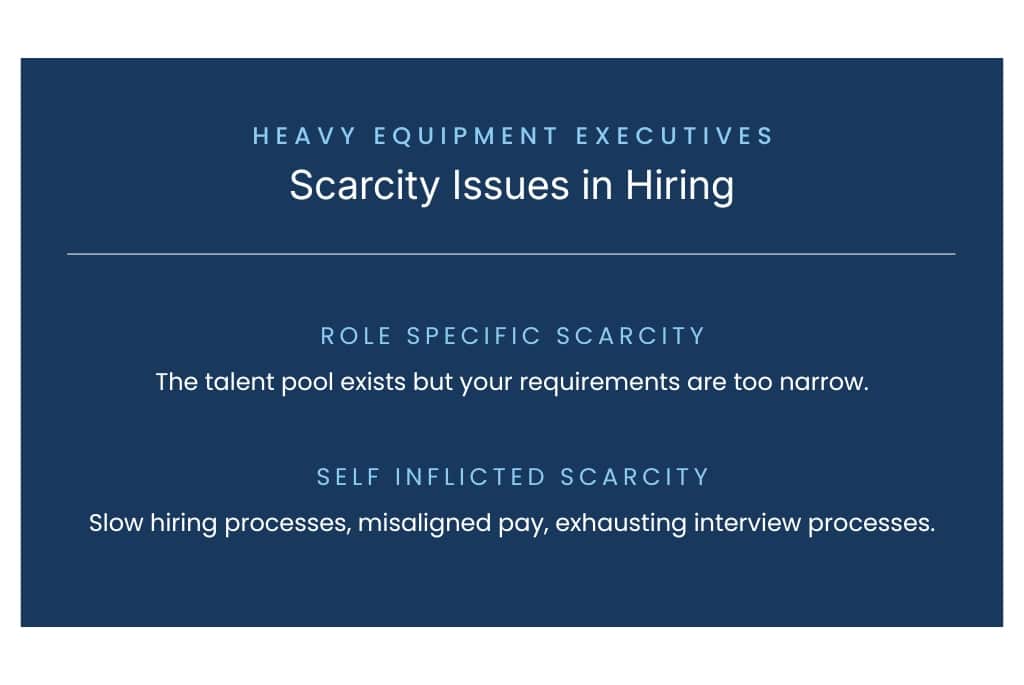
Role-specific scarcity means the talent pool exists, but your requirements are so narrow you’ve accidentally excluded 90% of it. Like insisting your next Branch GM must have exactly 12 years at a Caterpillar dealer in a city with a population between 50,000 and 75,000.
Self-inflicted scarcity is when your hiring process moves too slowly, your pay doesn’t match what the job requires, or your interview process is so exhausting that good candidates drop out before you make a decision.
Most executive hiring failures are the second and third type. The U.S. Bureau of Labor Statistics doesn’t show a shortage of leaders in construction and manufacturing. What it shows is normal turnover at normal levels. Translation: the people are out there. You’re just not set up to hire them.
Here’s what actually changed. When dealers consolidate, there are fewer GM jobs available. A regional player that used to have eight branches and eight GMs now has twelve branches and four regional directors. The ladder didn’t disappear. It just has fewer spots to climb to.
At the same time, the job requirements shifted. Your best Service Manager from 2015 was great at keeping technicians happy and parts flowing. Your best Service Leader in 2026 needs to think about repeat customers, monthly service contracts, and why certain accounts are profitable while others aren’t. McKinsey found that most experienced industrial leaders don’t have this skillset because nobody trained them for it.
The Roles That Actually Matter
The positions that stay open longest are Branch or Regional General Managers who can run a location profitably without constant oversight, VPs of Service who understand that the service department is often where you make your money, and Operations leaders who can keep jobsites safe, equipment running, and customers happy.
Why these roles? They require both old-school credibility (you need to know the business) and new-school business thinking (you need to run it differently than your predecessor did).
A Service VP today isn’t just managing mechanics. They’re running what’s often a bigger revenue stream than equipment sales. Bain’s research on industrial business models shows that parts, service, and repairs now drive most of the company value in equipment businesses, not the initial equipment sale.
But companies hiring for these roles still write job postings that say “15+ years in heavy equipment required.”
Why is that the wrong choice? Because a Fleet Manager who ran maintenance for 200 delivery trucks at a logistics company has more relevant experience than someone who spent 20 years inside one dealer doing the exact same job. The Fleet Manager dealt with keeping equipment running, managing mechanics spread across multiple locations, deciding what parts to stock where, and tracking cost per mile. That’s exactly what a modern service leader needs to do.
What someone can do matters more than where they did it. But hiring managers keep filtering for company logos instead of actual skills.
Posting Jobs Is Where Good Hires Go to Die
If your executive hiring strategy is posting on LinkedIn and waiting, I have bad news.
Executives worth hiring aren’t browsing job boards. They have a job. They’re reasonably happy. Even if they’re open to a move, they’re not filling out online applications like someone fresh out of college.
LinkedIn and workforce data underscore that talent acquisition for high-level roles depends heavily on personalized outreach and relationship-driven engagement because passive candidates make up the majority of leadership talent pools.
So where do companies actually find people when they stop waiting for applications to come in?
Look at adjacent industries. Industrial services, energy companies, and fleet management operations all produce executives who know how to run field teams, balance safety with productivity, and manage service businesses.
Promote people who aren’t obvious choices yet. Your best service director might be your next GM if you give them six months running a small P&L and some coaching on customer relationships.
Get serious about referrals. Not the “hey, know anyone?” version. Track who refers candidates. Make it easy to submit names. Follow up within 48 hours. When done right, referrals work better than recruiters because the person making the introduction has their reputation on the line.
McKinsey’s research on strategic workforce planning shows that companies that limit hiring to traditional or familiar talent pools significantly constrain their access to capable candidates, particularly for senior and specialized roles.
Your Interview Process Doesn’t Test What Matters
Most executive interviews waste everyone’s time. You ask behavioral questions. The candidate tells polished stories. Everyone nods. You check references. You make an offer. Six months later, the person can’t decide whether to stock an extra $80K in parts inventory or what to do when your biggest customer demands a tech on-site in two hours while you’re short-staffed.
Why? Because you tested how well they tell stories, not how well they make decisions.
Harvard Business Review’s research on interviews shows that without a consistent evaluation system, interviewers just go with their gut and hire people they like. That’s terrible if you’re filling a job that affects hundreds of employees and millions in revenue.
What actually predicts success? Give candidates real problems to solve.
A safety incident shuts down a jobsite and the customer is threatening to pull all their business. What do you do in the next two hours?
Your service department is losing money because techs spend too much time driving between jobs. Walk me through how you’d figure out why and how you’d fix it.
Test whether they understand the service business. Can they explain the tradeoff between keeping techs busy and getting to customers quickly? Check if field teams will actually listen to them. See if they can manage teams spread across hundreds of miles.
Why Good Candidates Turn Down Your Offers
You made it through sourcing, interviews, and reference checks. You made an offer. The candidate said no.
This happens more than companies admit, and the reasons are usually predictable.
Executive pay in heavy equipment is still tied to revenue growth and short-term profits, but the actual job increasingly revolves around service revenue, safety, equipment uptime, and keeping good customers. That mismatch shows up in how you structure bonuses… and candidates notice.
Good packages in 2026 tie pay to service department growth, customer retention, and operational stability.
Location kills more deals than money, especially for jobs in rural or secondary markets. When both spouses work, asking one to move to a town with limited job opportunities is a tough sell.
U.S. Census data show that overall geographic mobility in the United States has been steadily declining for decades, with relatively fewer households changing residence year over year. The American Community Survey’s mobility estimates reported a continued drop in the percentage of people moving in the previous 12 months, reaching some of the lowest levels on record.
Companies that ignore relocation challenges will keep losing finalists to competitors in better locations. Some reduce that friction by letting executives split time between regions or offering paid trial periods where the candidate can test living there before committing.
When Growing Your Own Leaders Works
Every company says they want to promote from within. Most don’t actually do it.
High-potential managers get stuck in the same role too long because there’s no clear way to know when they’re ready for the next level.
McKinsey’s research on people development shows that organizations prioritizing structured capability building promote internal talent at roughly 7% more than those that do not embed development deeply into their culture. They also realize better retention and internal career mobility. The difference isn’t the quality of people. It’s having an actual process.
Successful internal development programs set clear time limits on how long someone stays in a role. If someone’s been a branch manager for seven years and doing great, they’re either ready for more or they’ve plateaued. Leaving them there because “we can’t afford to lose them in that role” just means you’ll eventually lose them to a competitor who offers growth.
What to Do About It
If executive hiring feels harder than it used to, it’s because the old approach doesn’t work anymore. Companies waiting for the perfect candidate to show up aren’t competing. They’re just hoping.
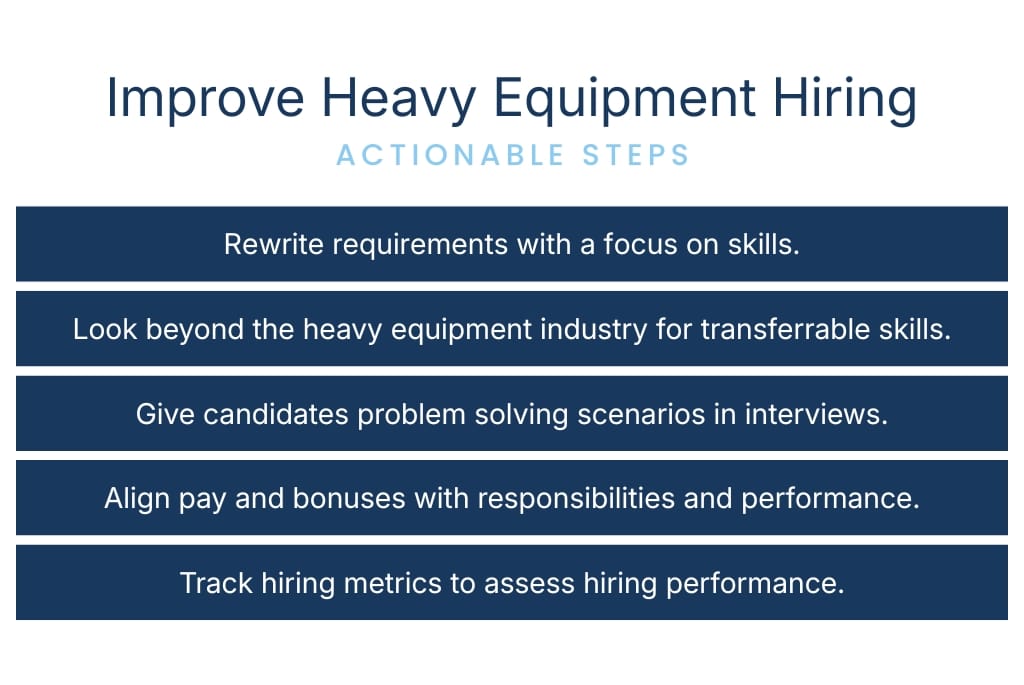
Rewrite your requirements around what people can do, not where they’ve worked. A leader who ran industrial services for a utility company might be a better Branch GM than someone with 20 years at a dealer, if they know how to run operations and keep customers happy.
Look beyond the heavy equipment industry. Test whether leaders from logistics, energy, or fleet management can do the job. Chances are, they can.
Replace storytelling interviews with real problem-solving. Give candidates actual scenarios. See how they think through decisions, not how well they rehearse answers.
Pay people for what the job actually requires. If the role is fundamentally about service revenue and keeping customers, tie their bonus to service revenue and customer retention.
Track what matters. How long does it take to fill executive roles? How often do you promote from within? How many good people are you losing? Why are finalists turning down offers? If you’re not measuring this, you don’t know if your hiring process works.
The companies winning executive talent in 2026 aren’t the ones with the biggest brands or the most job postings. They’re the ones who treat hiring leaders like the strategic decision it actually is.
If your current process isn’t working, it’s probably time to try something different. The Richmond Group USA helps heavy equipment distributors and OEMs find leaders who can actually do the job, not just interview well. Reach out today to begin the search for your next leader.