
More Than Numbers: What CEOs Expect from a Strategic Controller
The strategic controller role has changed faster than many accounting professionals realize. Accuracy and compliance are still required, but they no longer define success. CEOs now expect strategic controllers to help them make decisions, not just confirm results after decisions are already made.
This shift has created confusion in the market. Many job descriptions still list traditional controller duties, while interview conversations focus on judgment, business understanding, and systems fluency. Candidates sense the change but struggle to describe it clearly. CEOs struggle to hire for it.
This article explains, in plain terms, what a strategic controller actually does today, what traits CEOs look for, and how the role differs from traditional accounting leadership in 2026.
What A Strategic Controller Actually Does
A strategic controller is responsible for two things at the same time:
First, they ensure the company’s financial reporting is accurate, compliant, and defensible. This includes close processes, controls, reconciliations, and audit readiness.
Second, they help leadership understand what the numbers mean and what actions the numbers support or contradict.
That second responsibility is the difference.
A strategic controller:
- Identifies trends before they show up as problems
- Explains financial outcomes in operational terms
- Pushes back when forecasts or plans rely on weak assumptions
- Helps leadership evaluate tradeoffs using financial reality, not optimism
The role sits between accounting execution and business decision-making. It is still rooted in accounting, but its value comes from interpretation and judgment.
Why CEOs Now Expect More from the Strategic Controller Role
Three changes inside organizations have reshaped expectations.
Planning cycles are shorter. Many companies no longer rely on static annual budgets. They use rolling forecasts and scenario planning that change throughout the year. Controllers must react quickly and explain implications without waiting for perfect data.
Decisions rely more heavily on systems data. ERP (Enterprise Resource Planning) platforms now feed pricing, inventory, labor planning, and capital decisions. If controllers cannot explain where the data comes from or how reliable it is, leadership loses confidence in the output.
Boards demand clearer explanations. CEOs are expected to explain results and risks in plain language. Strategic controllers often help prepare those narratives and must understand the story behind the numbers.
As a result, CEOs hire controllers who can think forward, not just reconcile backward.
Strategic Controller Traits CEOs Consistently Look For
Technical accounting ability is assumed. It does not differentiate candidates at the senior level.
The traits below do.
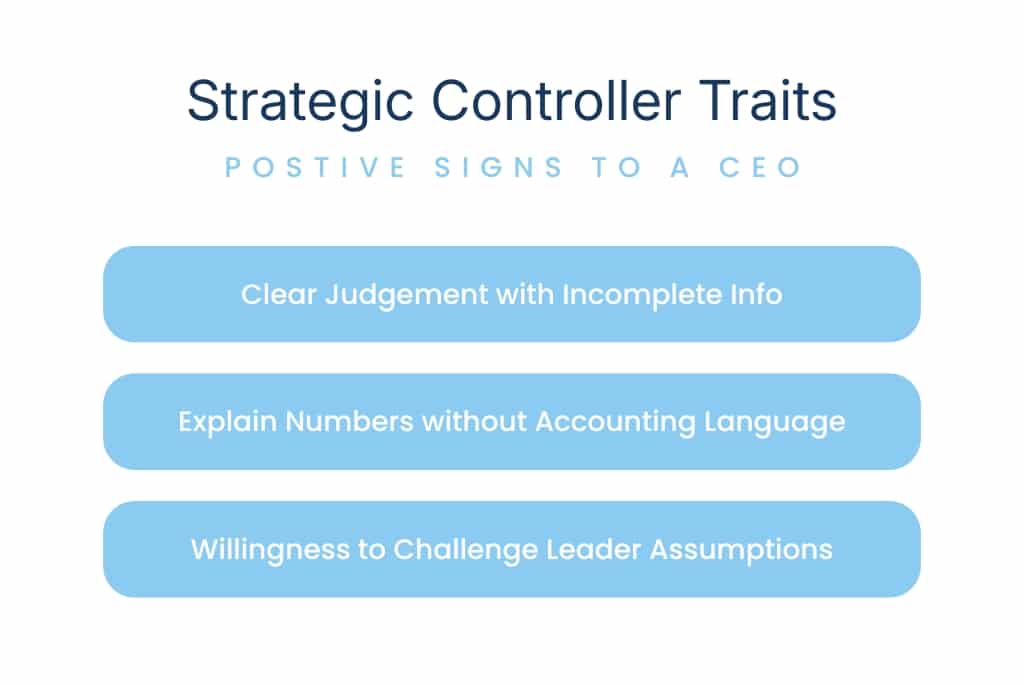
Clear Judgment When Information Is Incomplete
Strategic controllers rarely have full certainty. Data lags. Forecasts change. Leadership still needs answers.
Strong strategic controllers make reasoned recommendations based on available information and explain the limits of that information clearly. They do not delay decisions by waiting for perfect clarity.
This shows up during forecasting, cash planning, and risk discussions.
Ability To Explain Numbers Without Accounting Language
CEOs do not want explanations rooted in debits, credits, or accounting standards.
They want to know:
- Why margins changed
- What is driving cost increases
- Whether revenue trends are sustainable
Strategic controllers connect results to business activity. They explain financial movement using pricing, volume, labor, supply chain, or customer behavior.
Willingness To Challenge Leadership Assumptions
Strategic controllers are expected to disagree when plans are not financially realistic.
This does not mean being confrontational. It means raising concerns early, explaining the financial impact clearly, and offering alternatives.
CEOs value controllers who prevent bad decisions more than those who justify them later.
Cross-Functional Exposure Is a Requirement
Strategic controllers cannot operate effectively if their experience is limited to the accounting department.
CEOs expect them to understand how decisions are made across the business.
This usually comes from direct exposure to:
- Operations planning tied to cost and capacity
- Sales forecasting and pricing decisions
- Inventory management and working capital tradeoffs
- System implementations that affect data quality
Controllers with this exposure ask better questions and catch issues earlier. They understand where numbers come from and where they can break down.
Systems Knowledge Is Central to Strategic Accounting
Modern accounting depends on systems. Strategic controllers must understand how those systems work, not just how to extract reports.
This includes:
- Knowing how data flows through the ERP
- Understanding which metrics are automated and which rely on manual input
- Recognizing where system limitations can distort financial results
Controllers who blindly trust system outputs miss risk. Controllers who understand system mechanics can explain inconsistencies and prevent downstream errors.
According to the U.S. Bureau of Labor Statistics, accounting roles increasingly emphasize analytics and systems oversight rather than manual reporting, reflecting this shift in expectations.
The Strategic Controller as an Early Risk Detector
One of the most valuable contributions a strategic controller makes is identifying risk before it becomes visible to others.
This often involves noticing patterns such as:
- Receivables aging worsening despite stable revenue
- Inventory growth outpacing sales
- Labor costs creeping above planned levels
- Forecast assumptions drifting from actual performance
These signals rarely trigger automatic alerts. They require interpretation.
CEOs rely on strategic controllers to surface these issues early and explain their potential impact, even when the conclusions are uncomfortable.
How Accounting Background Influences Strategic Effectiveness
Not all accounting experience prepares someone for a strategic controller role.
Public accounting backgrounds often provide strong technical rigor and control awareness. Industry roles tend to build operational understanding. The strongest strategic controllers usually have exposure to both.
The American Institute of CPAs and CIMA emphasize that modern finance leaders are expected to combine strong accounting discipline with business and strategic capabilities, which explains why CEOs prioritize experience patterns over credentials alone.
Career Signals CEOs Use When Hiring Strategic Controllers
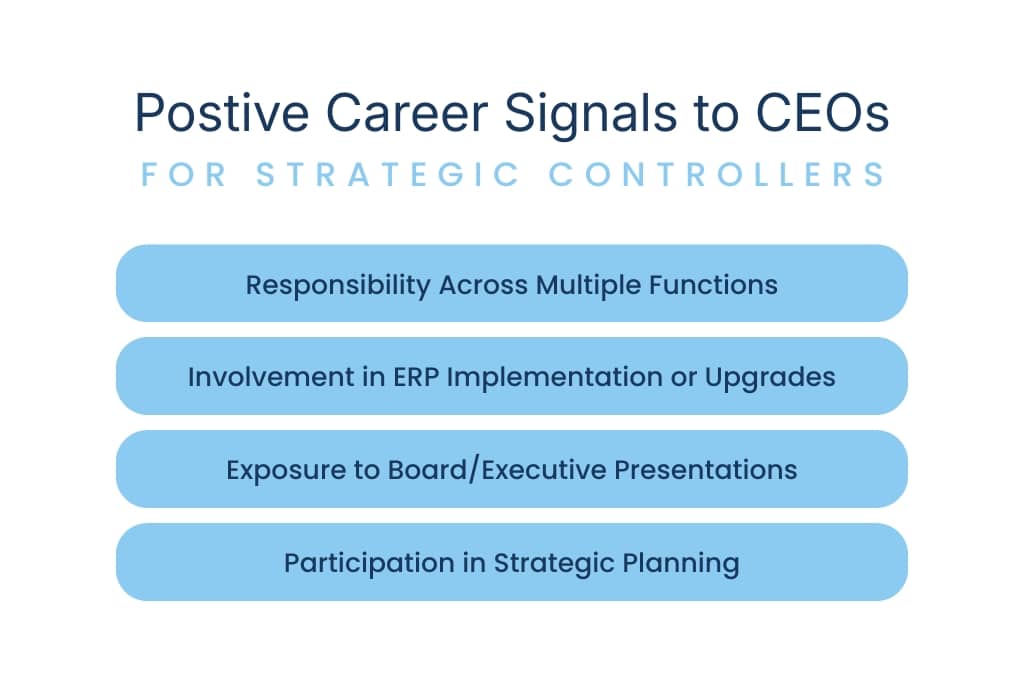
CEOs look for evidence that a candidate’s scope has expanded over time.
Signals that matter include:
- Responsibility across multiple business units or functions
- Involvement in ERP implementations or upgrades
- Exposure to board reporting or executive presentations
- Participation in strategic planning or capital discussions
Titles alone are less important than how the role evolved and what decisions the controller influenced.
Common Gaps CEOs See in Strategic Controller Candidates
Despite strong resumes, many candidates fall short in predictable ways.
The most frequent gaps include:
- Focusing on historical reporting without forward insight
- Explaining results using accounting terminology instead of business drivers
- Avoiding disagreement with senior leaders
- Limited understanding of how systems affect data reliability
These gaps reflect experience limitations, not intelligence. CEOs often hire around them rather than trying to train them out.
Where The Strategic Controller Role Is Heading
The strategic controller role continues to move closer to decision support and enterprise risk oversight.
Automation is reducing the value of manual reporting. At the same time, financial discipline is tightening across industries. Controllers who can connect controls to strategic flexibility will gain influence.
Those who remain focused only on compliance will see their impact shrink.
How The Richmond Group USA Sees the Strategic Controller Market
At The Richmond Group USA, conversations with CEOs and CFOs point to the same conclusion. Strategic controllers are no longer hired just to protect the numbers. They are hired to protect the business.
Organizations that succeed treat the role as a partner to leadership, not a back-office function. Candidates who understand this distinction position themselves more clearly and compete more effectively.
Key Takeaways for Candidates and CEOs
Strategic controllers succeed when they combine accounting expertise with judgment, business understanding, and systems awareness.
For candidates, advancement comes from expanding exposure and influence, not collecting credentials. For CEOs, the best hires are often those who explain complex financial reality clearly and early.
The numbers still matter. But the value comes from knowing what they mean and what to do about them.
If you’re looking for your next strategic controller role, talk to the accounting and finance team at The Richmond Group USA to see how we can help with your search!