
Executive Hiring: When Internal Promotion Beats External Search
Executive hiring rarely goes sideways because the interview process was sloppy. It goes sideways because the organization picked the wrong kind of leader for the moment it is in.
That’s the core issue when comparing executive search vs internal promotion. Many teams treat the hire as a value debate. Loyalty versus fresh thinking. Rewarding the bench versus buying talent. Those only distract from what matters.
The hiring method should be determined by the state of the business. When leaders mismatch the method to the situation, the company pays twice: once in compensation and again in lost momentum.
This article gives you a practical way to decide your method of hiring for executive roles. It also spells out the failure modes that most executive hiring strategies politely skip.
Table of Contents
What Executive Search & Internal Promotion Require
What Internal Promotion Requires to Work
Internal promotions succeed when they’re deliberately planned, not when they’re a convenient pick.
A real internal succession path usually includes three ingredients:
- Evidence of scope: the candidate has managed beyond their function, not just excelled inside it.
- Exposure to tradeoffs: they have owned decisions that upset someone, such as reallocating a budget or changing incentives.
- Credibility across the org: peers and direct reports already follow them when things get tense.
When those pieces are missing, internal promotion finds “the best available person” rather than “the right person.”
What Executive Search Actually Buys
Executive search is not just sourcing. A retained search process usually covers:
- Mapping the market and identifying who is actually doing the job you need
- Approaching candidates confidentially
- Benchmarking compensation and role scope
- Assessing leadership patterns and failure risk
Fees often run 25-35% of first-year compensation. That cost is not to be ignored, but the value often comes from something less obvious: external calibration.
An external search can tell you, bluntly, whether your internal candidate matches what the market considers “ready” for the role you are trying to fill.
When Internal Promotion Works Best
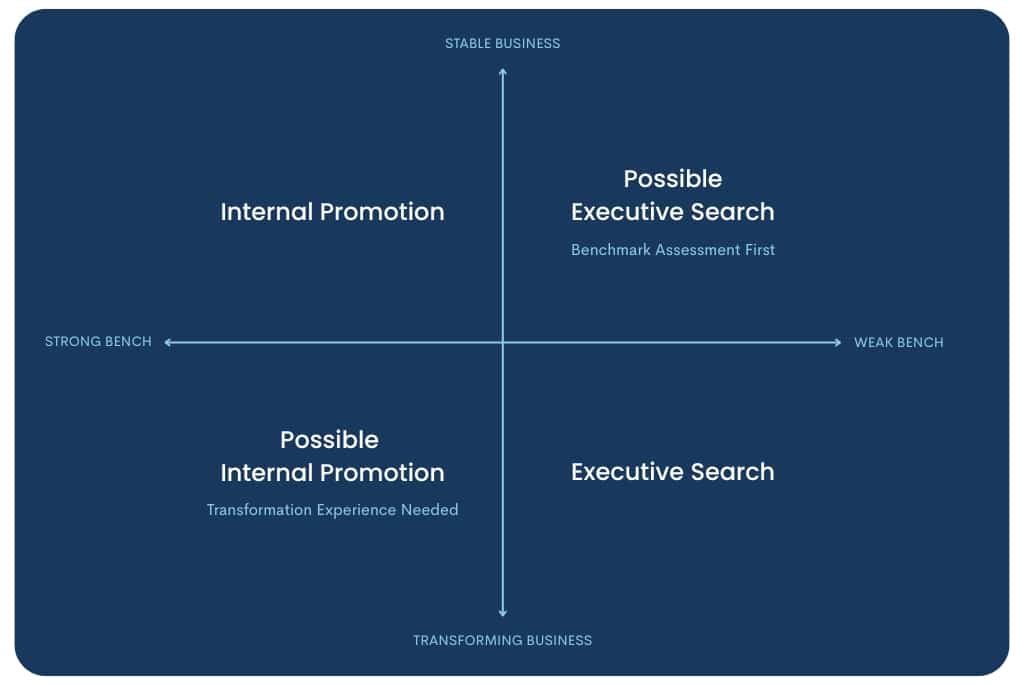
Internal promotion tends to outperform executive search when the business model is stable and the leadership bench has been built with intent.
Continuity Wins When the Strategy Is Steady
Wharton research found external hires receive lower performance evaluations in their first two years, cost more, and leave more often than internal promotions. The study remains a strong anchor for the “performance and retention” argument against external hires.
External executives spend their first year or so learning your organization’s unspoken rules. They figure out who really influences decisions, where processes break, and what history makes people defensive. Internal leaders already know the atmosphere of the business.
If your business runs on operational rhythm, supplier relationships, recurring customers, and predictable margins, the advantage of a leader with a “fresh perspective” shrinks. Execution speed matters more.
A plant-based consumer goods company promoting its VP of Operations to COO often avoids a painful reset because the new COO already knows where capacity constraints hide and which vendors routinely miss. With an external hire, you’ll be waiting months for them to learn the insides of the business before they gain insights like these.
Succession Planning Works When It Creates Proof, Not Hope
Many organizations say they have succession planning. What they really have is a list of people.
Deloitte’s research on leadership succession planning argues that disciplined, data-informed succession processes improve organizational stability and resilience, while many organizations derail the process through short-term thinking, unclear accountability, and subjective decisions.
The practical implication is simple: succession planning should create evidence of readiness through strategic planning.
Readiness looks like:
- Successful cross-functional leadership
- Strong performance through disruption
- An ability to influence leaders who do not report to them
If the internal candidate has only succeeded in one lane, promoting them into an enterprise role often forces a skills jump while the business expects immediate results.
Internal Promotion Can Stabilize the Second Layer
Turnover at the top can trigger turnover below it. People watch leadership choices and make inferences about their own career path based on these choices.
The U.S. Bureau of Labor Statistics continues to publish Job Openings and Labor Turnover Survey data showing millions of separations each month, and voluntary quits remain a meaningful component.
If your director and VP layer already feels fragile, internal promotion could hold the structure together. It signals that advancement happens, and it reduces the internal “wait and see” period that causes people to quietly take recruiter calls.
When Executive Search Works Best
Executive search creates outsized value when the company needs a change in capability, credibility, or operating model.
Executive Search Fits When the Company Is Changing Its Shape
McKinsey’s transformation research points to a consistent pattern: transformation efforts fail frequently, and experienced leadership improves odds of success.
A company expanding nationally, integrating acquisitions, modernizing a core system, or moving from founder-led decisions to scalable governance often needs leaders who have already lived through those types of shifts.
An internal leader can be smart, hardworking, and loyal, and still lack the pattern recognition that keeps transformations from stalling in month six.
Executive Search Helps When the Skill Gap Is Obvious
PwC’s 29th Annual Global CEO Survey reports that CEOs continue to cite technological disruption and AI integration as major business pressures, with many acknowledging the need to strengthen organizational capabilities to execute change
When the business needs a leader who can drive enterprise-wide change, the hiring team should be critical of the skills and experience possessed by the potential new leader and ensure they fully align with the changes that need to be made.
If no one internally has led a multi-year systems implementation, built modern revenue operations, or managed a national footprint, promoting internally can extend the learning curve while competitors keep moving.
External Hires Can Serve as a Public Reset
Boards often use CEO succession choices to signal changes in the way they operate. Empirical research shows that CEO turnover is strongly linked to firm performance, with boards significantly more likely to dismiss CEOs following sustained underperformance.
The logic behind it makes sense: external hires help boards demonstrate accountability. They also help break internal alliances that may have supported the old strategy.
This visible change of leadership affects investor confidence, lender conversations, and executive retention.
The Two Failure Patterns Most Teams Miss
Familiarity Bias Can Make Internal Candidates Look Ready
This is where misdiagnosis shows up.
Leaders confuse competence in a known environment with competence at a larger scope. They also confuse tenure with readiness.
An internal candidate who knows the business can still struggle when the role demands:
- Influencing peers who previously outranked them
- Owning enterprise tradeoffs that create losers
- Setting direction rather than managing execution
In practice, this is how “safe” internal promotions fail.
Cultural Friction Can Sink External Hires in the First 90 Days
External hiring risk often gets described as “culture fit,” which is vague and overused. The more precise issue is cultural integration under time pressure.
Cultural friction shows up as:
- The executive pushes change before building internal sponsorship
- The executive assumes authority travels with title and it does not
- The executive underestimates historical landmines and triggers resistance
This is why Wharton’s data on early underperformance and higher exit rates for external hires makes sense in real life. The risk is less about talent and more about integration.
What The “Cost” Conversation Should Include
Search fees attract attention because they are a line item. The financial drag from mis-hiring is quieter and often worse.
According to the U.S. Bureau of Labor Statistics, the median annual wage for chief executives exceeds $200,000 nationally, with compensation significantly higher at the upper percentiles and in certain industries, underscoring the financial stakes of executive hiring decisions.
The bigger cost usually comes from downstream effects:
- A stalled transformation wastes software spend and leadership attention
- A weak commercial leader misses revenue targets and loses top sales talent
- A poor operations leader creates churn in plant leadership and quality roles
- A confused strategy triggers customer drift
That is what “strategic delay” means.
A Practical Way to Choose Without Overthinking It
Use three questions, but answer them with real criteria.
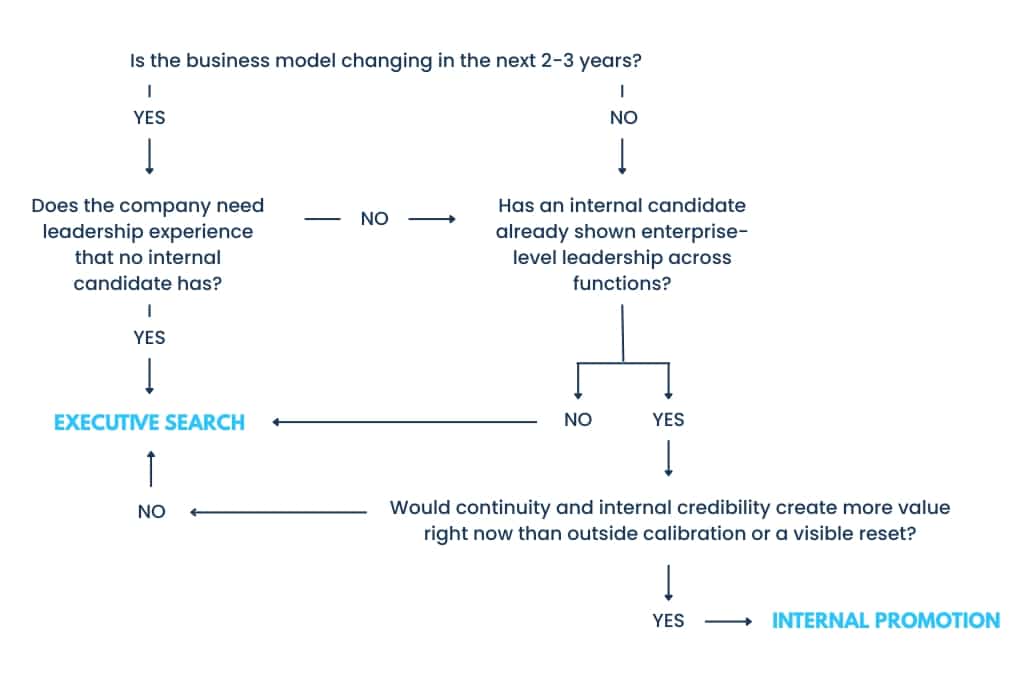
Is The Business Model Changing in the Next Three Years
“Changing” means any of the following:
- New markets or channels that alter go-to-market
- M&A integration that changes the org chart and systems
- Major modernization effort that shifts how the company runs
- Ownership changes that alter expectations and reporting
If those are on the table, executive search often brings necessary experience.
Has The Internal Candidate Already Shown Enterprise-Level Leadership
Enterprise-level leadership shows up when a candidate has:
- Led across functions
- Delivered results through disruption
- Influenced stakeholders without direct authority
If the internal candidate has only succeeded in one lane, the promotion may be a leap disguised as a step.
Has The Company Benchmarked the Role Against the Market
Benchmarking does not require hiring externally. It requires testing assumptions.
A search process can tell you:
- What comparable leaders have done before
- What compensation looks like for that scope
- What the market considers a realistic candidate profile
Even companies committed to internal promotion benefit from this. It reduces blind spots.
Closing Takeaway
Internal promotion rewards sustained investment in leadership development and often delivers faster execution when the company is stable.
Executive search delivers value when the company needs different experience, a capability jump, or a credibility reset.
The wrong move usually happens when a team treats the decision as a belief system rather than a business diagnosis.
For hiring teams in the United States, a clear-eyed assessment of future direction, bench strength, and market reality produces better outcomes. Firms like The Richmond Group USA often see both paths work when the company chooses based on evidence, not comfort.
If you’re considering an executive search, The Richmond Group USA offers contingent, retained, confidential, and interim search options to help you find the leader you need. Reach out today to talk about your needs!