
The Future of Technical Sales Teams: Smaller, Smarter, and Consultative
Technical sales is evolving beyond a traditional quota-driven function. Buyers now research deeply before ever engaging a rep, and technology is reshaping not just how sales get done but who does it and with what skills. For technical sales managers, business leaders, and heads of sales teams, grasping the shifts underway isn’t optional. It determines competitiveness and revenue performance.
This article unpacks why technical sales teams in the United States are trending toward smaller headcounts, greater consultative value, and smarter execution. It draws on the latest industry insights, real business shifts, and actionable guidance for building teams that win in 2026 and beyond.
Table of Contents
What is classified as “Technical Sales”?
At its core, technical sales covers selling complex products or solutions where deep product, engineering, or scientific understanding matters as much as sales skills. It sits at the intersection of engineering and client engagement: conveying not just what a product does, but how it solves specific customer problems.
In complex B2B deals, from enterprise software to industrial equipment, technical sales professionals translate intricate technical details into value outcomes for buyers. This process typically involves tailored demos, specification discussions, and often multiple decision-maker interactions.
How Technical Sales Teams Are Changing
Several intersecting forces are reshaping technical sales teams in 2026:
Buyers Control the Early Journey
B2B buyers complete most of their research before engaging with a rep. Data shows roughly 70 to 90 percent of the buyer journey occurs before a sales conversation. That means sellers see prospects later and must add clear value immediately.
Sales teams are responding by compressing headcounts and increasing the quality of engagements. Smaller, more expert teams can focus on high-impact interactions instead of chasing early-stage exploration that buyers now do independently.

AI and Automation Take Over Routine Tasks
Sales technology is no longer peripheral. AI agents now automate research, outreach sequencing, data entry, and follow-ups; tasks that once consumed significant human time. Some leaders are pushing this further: recent reports highlight organizations experimenting with AI agents handling sales tasks end-to-end, with human oversight limited to high-value judgment calls.
This isn’t about replacing human judgment entirely. It’s about shifting human effort toward areas where judgment matters most: diagnosing needs, handling nuanced negotiations, and shaping complex solution design.
Hybrid Engagement Models Become Standard
Winning teams blend virtual and in-person touchpoints purposefully. Virtual interactions handle broader discovery and routine progress, reserving face-to-face (or high-touch) meetings for closing complex deals or negotiating multi-stakeholder terms.
Best-practice teams tie every in-person interaction to forecasted revenue impact instead of defaulting to a travel-heavy cadence.
Skills That Separate Good from Great Technical Sellers
In a smaller, smarter world, technical sales specialists need more than product knowledge. Sales leaders are doubling down on skills that directly move deals forward:
- Deep technical and domain expertise that bridges product capability to customer ROI.
- Consultative problem diagnosis that turns buyer ambiguity into clarity.
- Experienced negotiation and executive communication across stakeholders.
- Continuous learning mindset given how fast technical landscapes shift.
This mix makes sellers harder to replace with automation and more valuable in conversations where risk, integration complexity, and business impact are on the table.
Why Teams Are Becoming Smaller
Smaller technical sales teams are emerging for three linked reasons:
- Technology amplifies individual productivity. With AI managing outreach and preliminary qualification, fewer reps can cover the same account base while preserving personalization and speed.
- Buyers filter themselves early. When prospects do deep upfront research, fewer low-value calls are needed. Resourcing shifts toward handling later-stage deals where expertise matters.
- Talent specialization beats generalist quantity. Teams with broad technical depth outperform larger teams where sellers carry only surface product knowledge. Think of a small team of sales engineers and consultative specialists versus a large crew of generalists who can’t answer integration or engineering questions on the spot.
This trend mirrors shifts in the broader sales landscape where companies optimize headcount around value per interaction, not interaction count.
Designing A High-Performance Technical Sales Team
To build a team ready for 2026, leaders must rethink structure, processes, and talent development:
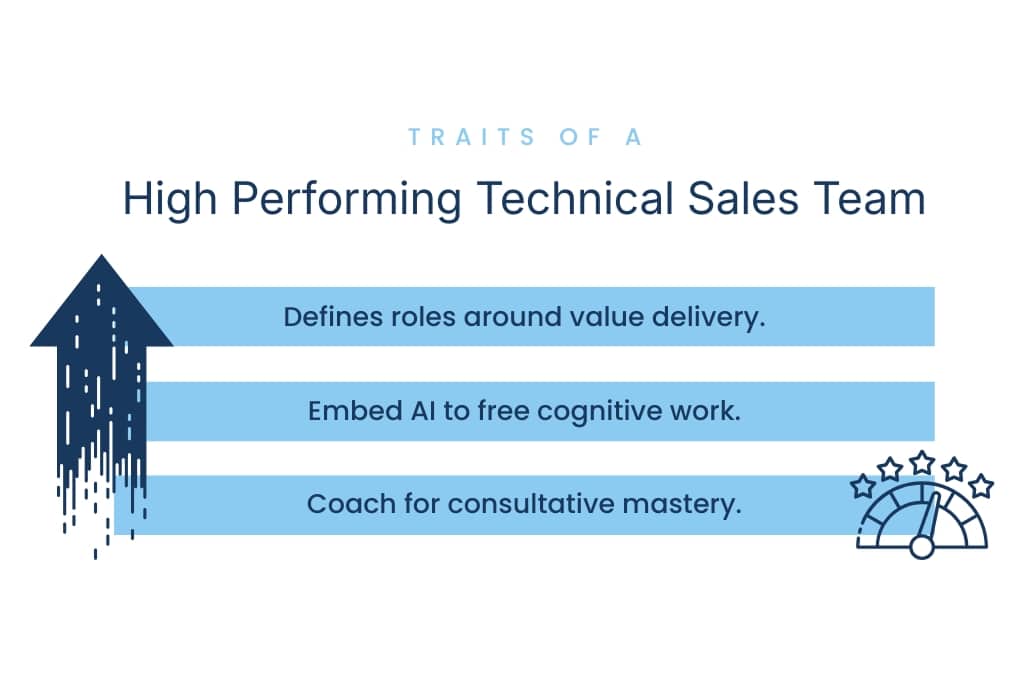
Define Roles Around Value Delivery
Traditional tiers like SDR, AE, and AM still matter, but within technical sales they should ladder up to a consultative value function. Examples include:
- Technical Sales Engineers who drive deep integration discussions and product architecture alignment.
- Solutions Consultants who translate business pains into tailored solutions.
- Customer Success Liaisons embedded early to assure post-sale confidence.
These roles reduce friction in complex deals and keep specialist skills focused on areas with the highest ROI.
Embed AI to Free Cognitive Work
AI tools should not sit in technology silos. They must be part of daily workflows, surfacing next-best actions, auto-drafting communication, and summarizing account insights in real time. Teams that treat AI as a co-pilot, not just a static toolset, see measurable productivity gains. This shapes how they hire, train, and evaluate performance.
Coach for Consultative Mastery
Technical sales training should prioritize real-world scenario practice over certification checkboxes. Use simulation and contextual AI immersion to rehearse negotiations, complex objections, and multi-stakeholder alignment. These skills directly impact pipeline conversion. Deep consultative capability lets a team focus on fewer but larger and more profitable deals.
Trends to Watch for in Technical Sales
Sales Planning Cycles Will Get Shorter
Traditional quarterly planning cycles are becoming liabilities. With AI summarizing data and suggesting strategy adjustments, planning is shifting to weekly or even daily realignments to market signals. This compresses strategy development and execution into a more dynamic rhythm.
Outcome-Based Engagement Metrics Trump Activity Metrics
Instead of tracking touch counts or meeting volumes, high-performing technical sales teams prioritize metrics tied to deal progression value. This incentivizes meaningful conversations rather than activity for activity’s sake.
What This Means for Managers and Leaders
2026 technical sales leadership requires a different mindset:
- Prioritize buyer psychology and research behavior over rep availability.
- Train and promote technical communicators who can work across departments.
- Lean into data-informed decision making (not just dashboards but predictive insights).
- Reward outcomes that reflect business value, like deal velocity and customer retention.
Technical sales is no longer about rote pitches or heavy headcounts. It is about smart engagement, precise expertise, and aligning human effort with moments that most impact revenue.
Conclusion
Technical sales in 2026 is smaller by necessity, smarter by design, and far more consultative than in past decades. Buyers demand insightful conversations and rapid value alignment, and technology is rapidly enabling sellers to meet that expectation without bloated teams.
The Richmond Group USA recommends leaders focus on building teams that combine deep technical knowledge with consultative proficiency while leveraging AI to eliminate friction. Those who do so will win larger deals faster and attract long-term customer loyalty.
For technical sales managers and business owners ready to refine their approach, start with aligning roles around customer value and evaluate where AI can free your team for the conversations that matter most.
Technical Sales Recruitment at The Richmond Group USA
Technical sales recruitment focuses on placing sales professionals who can sell complex, technical products; not just pitch them. These roles sit at the intersection of engineering, product, and revenue.
At The Richmond Group USA, we recruit technical sales talent (primarily in the equipment and automation industries) who understand specifications, workflows, and buyer pain points, then translate that knowledge into measurable growth. If your product requires more than a script to sell, technical sales recruitment isn’t optional; it’s essential.
Our focus is helping place high-quality technical sales & marketing talent across the US. We work with small, mid, and large size organizations. We uncover hidden talent and creative solutions that increase the value of your organization.
As specialists in the equipment industry, we understand your needs. We are your one-stop solution provider in the technical sales and marketing space. For more information about our technical sales recruitment, reach out to our team member Terri Kubicki to start the conversation.