

Job Hugging In 2026: Why More Workers Are Staying Put
More than half of employees are staying in their jobs out of necessity, not because they truly want to. That’s the unfortunate reality we face in 2026.
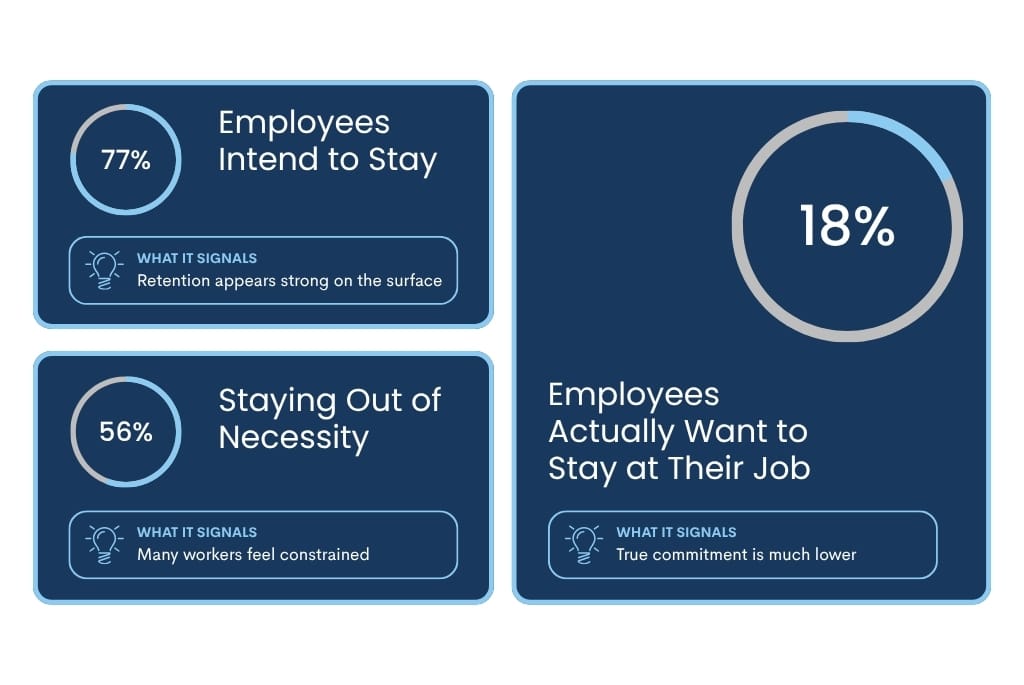
MetLife found that 56% of employees are staying put out of necessity, while 77% say they intend to stay with their current employer. Only 18% say they plan to stay because they genuinely want to.
Job hugging doesn’t happen because of the love people have for their job; it happens because people are scared or cautious.
Table of Contents
What Job Hugging Means
Job hugging is not just staying in a job; it’s staying in a role you would be more willing to leave under better conditions.
The employee may feel underpaid, burned out, bored, or stalled, but still decide that moving now carries too much risk. Job hugging captures something more specific than ordinary retention: it describes workers who are staying because the outside market feels less safe than their current situation.
A person can remain in a job without feeling committed to it. They may simply believe that this is a bad time to gamble. In 2026, that’s a rational conclusion for a lot of workers. MetLife’s data supports that interpretation directly: people are staying in their roles at high rates, but many are staying because they feel they need to, not because they feel strongly attached to where they are.
Why More Workers Are Staying Put
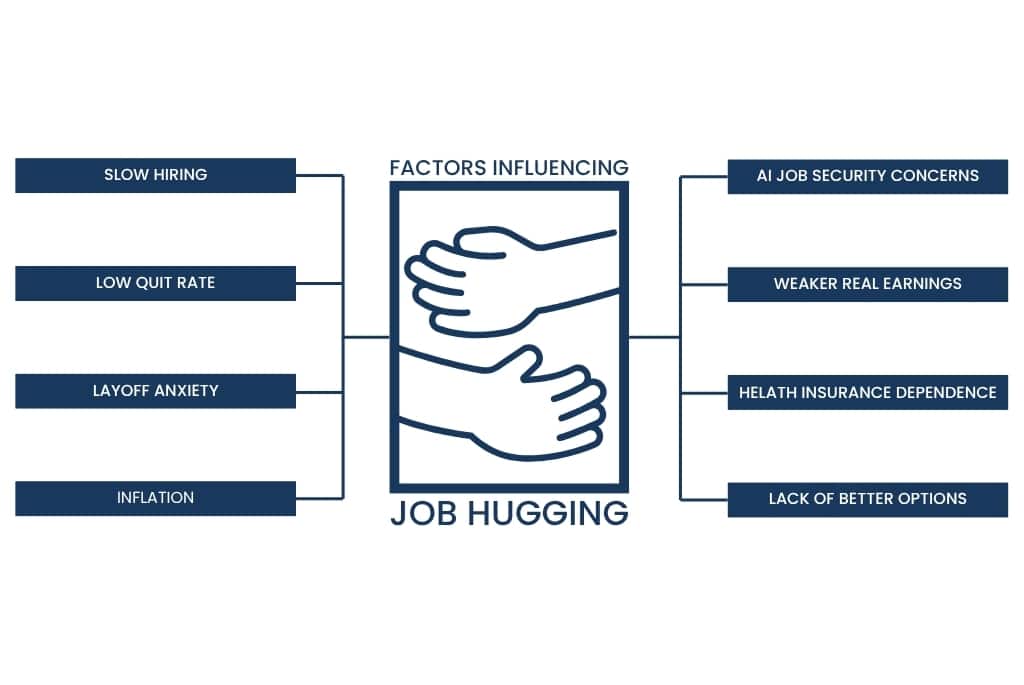
The biggest driver of the job hugging trend is a labor market that still functions but no longer feels easy to move through. The latest JOLTS data shows a quits rate of 1.9% in February 2026, a hires rate of 3.1%, and a job openings rate of 4.2%, with 6.882 million job openings nationwide. Those are not collapse-level numbers, but they do point to a slower and less fluid market than workers saw when job switching felt easier and confidence was higher.
The quit rate matters most here. When workers feel good about their chances, they quit more freely because they believe they can land somewhere better. When quits stay low, it usually signals that workers are less willing to take that risk. This is when job hugging begins to present itself. It grows when people decide that holding onto what they have is safer than testing a market that no longer feels generous.
The Economic Forces Behind Job Hugging
The labor market is only part of the story. The cost of making a mistake matters just as much. In March 2026, the unemployment rate was 4.3%, but the same BLS report showed 1.8 million people were long-term unemployed and 4.5 million people were working part time for economic reasons, meaning they wanted full-time work but could not get it. In a market like this, a move that goes wrong may not lead quickly to an equivalent job. It may lead to a longer search, weaker pay, fewer hours, or a less stable landing.
Inflation and household costs make that downside harder to absorb. In March 2026, consumer prices were up 3.3% from a year earlier. The CPI release also showed energy prices jumping sharply for the month, driven by a 21.2% monthly increase in gasoline, the biggest monthly rise in that series since 1967. Real average weekly earnings fell 0.9% in March, which means workers were losing purchasing power even while remaining employed.
That’s exactly the kind of economic backdrop that makes a steady paycheck, health insurance, and known benefits feel more valuable than chasing a potentially better role. Job hugging rises when the downside of change starts to outweigh the upside of opportunity.
What the 2026 Job Hugging Data Shows
The survey data makes the trend more explicit. In February 2026, ResumeBuilder found that 57% of workers identified as job huggers, up from 45% in August 2025. It also found that 70% worry AI will affect job security and 63% worry about layoffs in the next six months. Workers are not only seeing a weaker job market; they’re also worrying about what automation, restructuring, and employer cost-cutting could do to their options.
Job hugging is a response to layered uncertainty: slower hiring, real financial pressure, layoff anxiety, and concern that future openings may be narrower or more competitive than expected.
Job Hugging vs. Quiet Quitting
These ideas overlap, but they are not the same. Job hugging is mainly about external risks. Quiet quitting is mainly about internal disengagement.
A job hugger may still work hard. They may be fully aware that the role is no longer ideal, but keep performing because they want to protect income, benefits, seniority, or stability while conditions remain uncertain. Quiet quitting is different. That behavior is more about emotional withdrawal, reduced effort, or doing only what is required. An employee can do one without the other.
Why Job Hugging Carries Risks for Workers
Job hugging can be rational in the short term, but it still comes with costs. A worker who stays too long in a role that no longer fits may delay raises, promotions, better titles, new skills, and stronger opportunities. The risk is not only that they stay. It’s that they normalize staying. Waiting six months for better conditions can quietly turn into an eighteen-month waiting period.
While job huggers may feel like they’re making the safe choice in the moment, it points to the possibility of stagnation. A strategy that protects stability now can still reduce growth later.
Why Employers Should Not Mistake It for Loyalty
For employers, the mistake is assuming that low turnover automatically reflects a healthy culture. It may not. A cautious labor market can retain people that a stronger labor market would pull away. MetLife’s findings are the clearest warning here: a large share of employees are staying, but far fewer are staying because they genuinely want to. That means some organizations may be benefiting from fear-based retention rather than earned commitment.
If external conditions improve, that illusion can break quickly. A workforce that looks stable today may prove much less loyal once workers feel safer making a move.
What Happens Next If the Economy Stays Uneven
Low quits rates, softer hiring, long-term unemployment, cost pressure, and weaker real earnings all make staying put easier to justify.
If the economy continues to be unsteady, we will likely see an increase in job hugging. Economic pressure and fears about the influence of AI will likely continue to push people to seek safety rather than pushing them to take risks in new roles.
While this means easier employee retention for companies right now, business owners should be wary about the consequences they’ll face when conditions improve. People who are not satisfied with their jobs right now will likely leave at the first sign of improving conditions in the market or when presented with a more enticing offer.
If the talent you’re looking for seems to be reluctant to move jobs, let the recruiters at The Richmond Group USA help with your search. We’re experts at interacting with passive candidates and giving them the confidence they need to make the right move. Let us help you secure the talent you need for your next role!
