Beyond The Plant: How Manufacturing CEOs Are Redefining Growth
Manufacturing growth in the United States is no longer determined by how well a plant runs. The ceiling for many manufacturers is being set years earlier, often in capital planning meetings, site selection decisions, and technology roadmaps that never touch the shop floor.
This shift has changed how manufacturing CEOs are evaluated. Strong operations are assumed. What differentiates leaders now is how they allocate capital, interpret data, and absorb risk across increasingly expensive and irreversible decisions.
The plant still matters. It’s just no longer where growth is decided.
Table of Contents
Why The Manufacturing CEO Role Is Under Pressure
Manufacturing has entered a phase where strategic errors compound faster than operational ones. Capacity is more expensive to build, harder to unwind, and slower to repurpose. A single misjudged investment can drag performance for a decade.
U.S. Census “Value of Construction Put in Place” data (reported as a seasonally adjusted annual rate) shows manufacturing construction rising from about $95B in December 2021 to about $228B in December 2024, and Federal Reserve analysis links much of that surge to incentives from the CHIPS and Science Act and the Inflation Reduction Act, alongside demand tied to semiconductors and batteries and reshoring pressure.
This level of capital intensity has altered the CEO’s job. When billions are committed before a line produces revenue, growth becomes a function of judgment rather than execution.
Boards now care less about whether a CEO can run a plant and more about whether they can decide which plants should exist at all.
The Shift from Operational Control to Enterprise Judgment
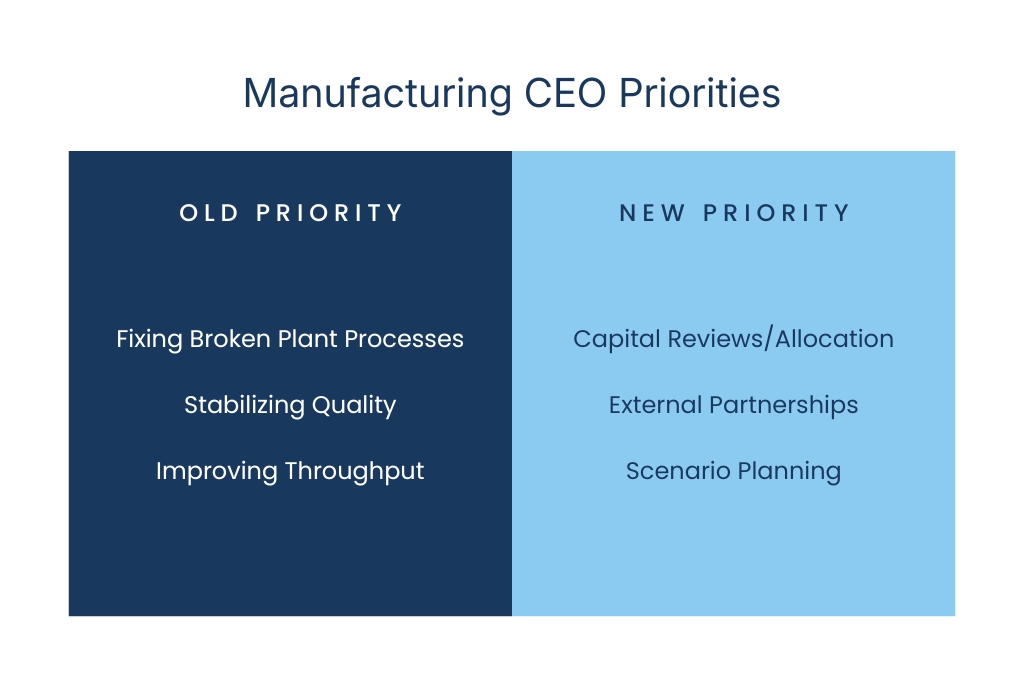
The historical manufacturing CEO archetype was built on operational mastery. Many of today’s CEOs earned credibility by fixing broken plants, stabilizing quality, or improving throughput. That background still matters, but it is no longer sufficient.
Growth decisions now live upstream. Capital sequencing, supplier exposure, labor availability, and regulatory incentives determine outcomes long before operations teams engage. CEOs who stay deeply embedded in day-to-day execution often lose altitude on these decisions.
In practice, this shows up in time allocation. Strategy-first manufacturing CEOs spend more time on capital reviews, external partnerships, and scenario planning than they do walking lines. They rely on operational leaders to execute rather than personally intervening.
The risk is not disengagement. The risk is staying too close to the plant while enterprise-level decisions drift.
Data Fluency Is No Longer Optional for Manufacturing CEOs
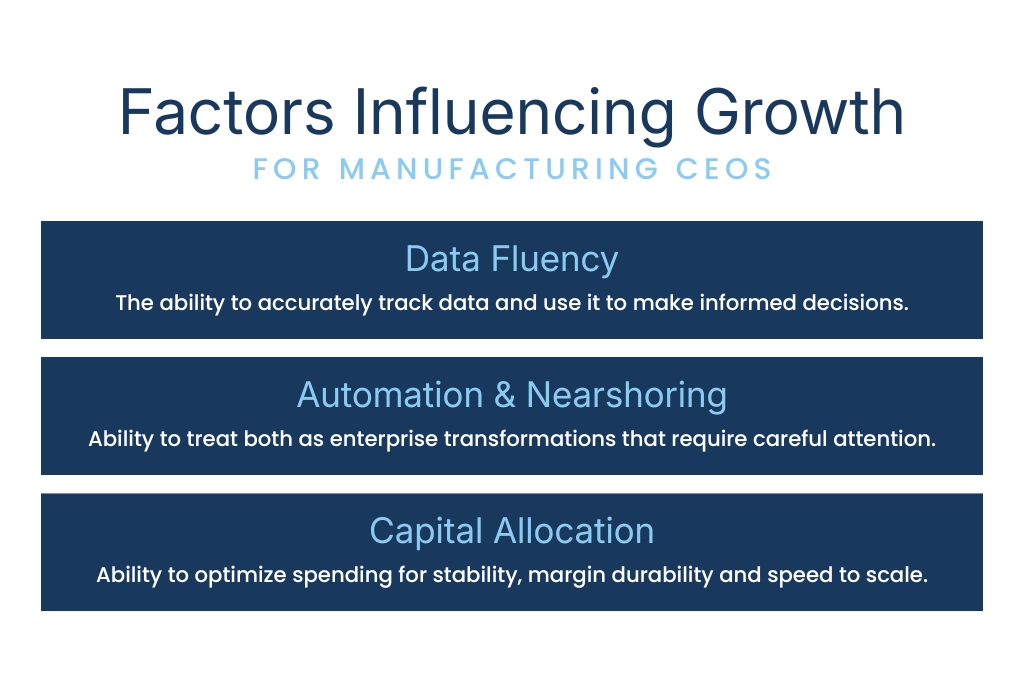
Many manufacturers have already invested in data tools and systems. The harder part is turning all that information into something leaders can use to make big calls, like where to spend capital, what to prioritize, and how to balance production needs with financial targets.
That’s where things often break down. Different dashboards tell different stories. Teams use the same metrics in different ways. Forecasts depend on assumptions that aren’t easy to see or question. When the numbers don’t line up, leadership discussions can shift from deciding what to do to simply getting everyone on the same page.
Smart manufacturing helps when it’s built to support day-to-day decisions, not just produce more reports. Organizations that implement it well often see real operational gains: 10% to 20% higher production output, 7% to 20% better workforce productivity, and 10% to 15% more usable capacity, once the data reflects how the business actually runs.
When digital efforts stall, it’s rarely because the software “didn’t work.” More often, the organization hasn’t connected shop-floor data to financial impact and investment decisions. Without that link, automation improvements stay small and analytics become something you review after the fact instead of something that guides the next move.
Smart manufacturing delivers the most value when it helps leaders answer practical questions: what to fund, what to scale, what to fix first, and where the real constraints are.
Automation and Nearshoring Are Stress Tests for Leadership
Automation and nearshoring are often discussed as operational responses to labor shortages and supply chain risk. In reality, they expose leadership weaknesses quickly.
Nearshoring is frequently positioned as a solution. Execution is rarely clean. Domestic sites often ramp slower than planned, cost more than modeled, and require different talent profiles than legacy plants.
Automation compounds the challenge. Organizations that pursue it as a labor replacement tactic encounter resistance. Those that frame it as a capacity and reliability lever tend to move faster.
These initiatives cannot be delegated without consequence. When CEOs step back too far, automation programs fragment and nearshoring timelines slip. When they overreach, organizations freeze.
Growth-oriented manufacturing CEOs treat both as enterprise transformations, not projects.
Growth Is Being Redefined in Capital Terms
Volume growth still matters, but it no longer defines success on its own. In capital-heavy manufacturing environments, growth increasingly shows up as stability, margin durability, and speed to scale.
This reframing explains why some manufacturers expand capacity yet underperform peers. Capital deployed without a clear operating model often produces revenue without resilience.
CEOs who scale effectively tend to evaluate growth through narrower lenses. They ask whether investments:
- Reduce volatility across cycles
- Improve ramp predictability
- Create optionality rather than lock-in
These questions rarely appear in quarterly reviews. They dominate long-term performance.
Why Capital Allocation Is Where CEOs Most Often Miss
One of the least discussed realities in manufacturing leadership is how often capital is misallocated by otherwise capable CEOs.
The failure pattern is consistent. Leaders overweigh incentives, underestimate execution drag, or assume that past success translates cleanly into new operating contexts. Nearshored facilities built on legacy assumptions are a common outcome.
CEOs who avoid this trap tend to slow decisions rather than rush them. They stress-test assumptions across labor, technology, and demand simultaneously rather than sequentially.
This discipline is not visible on resumes. It shows up in how leaders talk about investments that did not work.
How Manufacturing Leadership Teams Are Quietly Changing
As the CEO role shifts, leadership teams are being rebuilt around integration rather than hierarchy.
Manufacturing organizations increasingly rely on leaders who sit between functions. Digital operations, advanced manufacturing, and transformation roles have emerged to manage complexity that traditional structures cannot absorb.
CEOs who fail to evolve their teams often become the integration point themselves. That model collapses as scale increases.
How The Richmond Group USA Evaluates Growth-Oriented Manufacturing CEOs
In manufacturing CEO searches, past titles matter less than decision patterns.
The Richmond Group USA pays close attention to how candidates describe capital decisions, digital investments, and organizational tradeoffs. Leaders who have scaled growth in capital-intensive environments speak differently about risk, timing, and failure.
They do not describe growth as inevitable…they describe it as engineered.
This distinction becomes critical as manufacturers commit to long-cycle investments that will define performance well beyond a single CEO tenure.
What This Means for Manufacturing CEOs
Manufacturing CEOs are being judged less on operational command and more on enterprise judgment. The leaders who succeed understand where growth is actually decided and where it is merely executed.
The plant remains essential. Growth, however, is increasingly shaped elsewhere.