How to Reduce Late-Stage Candidate Dropouts in R&D Hiring: Lessons from Recent Placements
Hiring leaders across U.S. R&D teams are running into a familiar problem. The candidate pipeline looks strong. Technical assessments check out. Interviews go well. Then, late in the process, momentum breaks. Offers stall. Candidates hesitate. Some walk away entirely.
This pattern is not driven by compensation alone or by skill mismatches. Recent placements across research, formulation, analytical development, and applied engineering roles show a more consistent root cause. Many R&D professionals make career decisions through a kinesthetic lens. They rely heavily on how a role feels, how the environment resonates, and whether the move aligns with personal and family expectations. When hiring strategies ignore that reality, misalignment shows up late and expensively.
This article breaks down what recent successful placements reveal about building stronger R&D teams. The focus is not employer branding or speed. It’s alignment. Emotional, financial, and personal alignment, handled deliberately before an offer is on the table.
Why R&D Hiring Breaks Down Later Than Other Functions
R&D Candidates Process Decisions Differently
A consistent pattern emerges in R&D hiring. Many candidates are deeply hands-on thinkers. Their confidence comes from experimentation, iteration, and problem-solving in real environments rather than abstract discussion. This kinesthetic orientation affects how they evaluate new roles.
While sales or commercial candidates may decide quickly based on scope or title, R&D professionals tend to internalize the decision. They imagine daily workflows. They picture lab setups, team dynamics, and autonomy. If those emotional cues are unclear or unresolved, hesitation surfaces late.
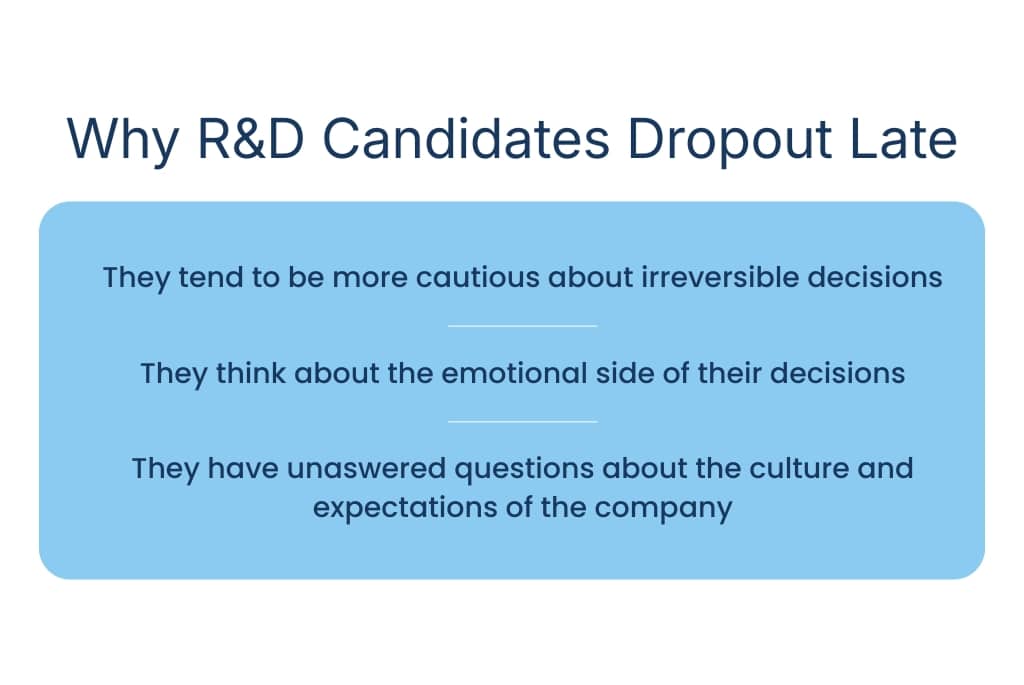
Research from the National Science Foundation shows that R&D roles often involve higher ambiguity tolerance and longer project horizons than other professional functions. That same tolerance makes candidates more cautious about irreversible decisions like changing employers or relocating families.
Technical Fit Is Necessary but Rarely Decisive
Most failed R&D hires were technically qualified. Hiring managers often assume that strong skills signal readiness to commit. In practice, technical alignment only clears the first gate.
Late-stage dropouts often trace back to unresolved questions about management style, organizational stability, or how success is measured. These are emotional considerations, even when framed rationally. When recruiters stay purely transactional, those questions remain unanswered until the offer stage.
Talking to R&D Candidates in a Way That Actually Resonates
Emotional Context Matters More Than Pitching
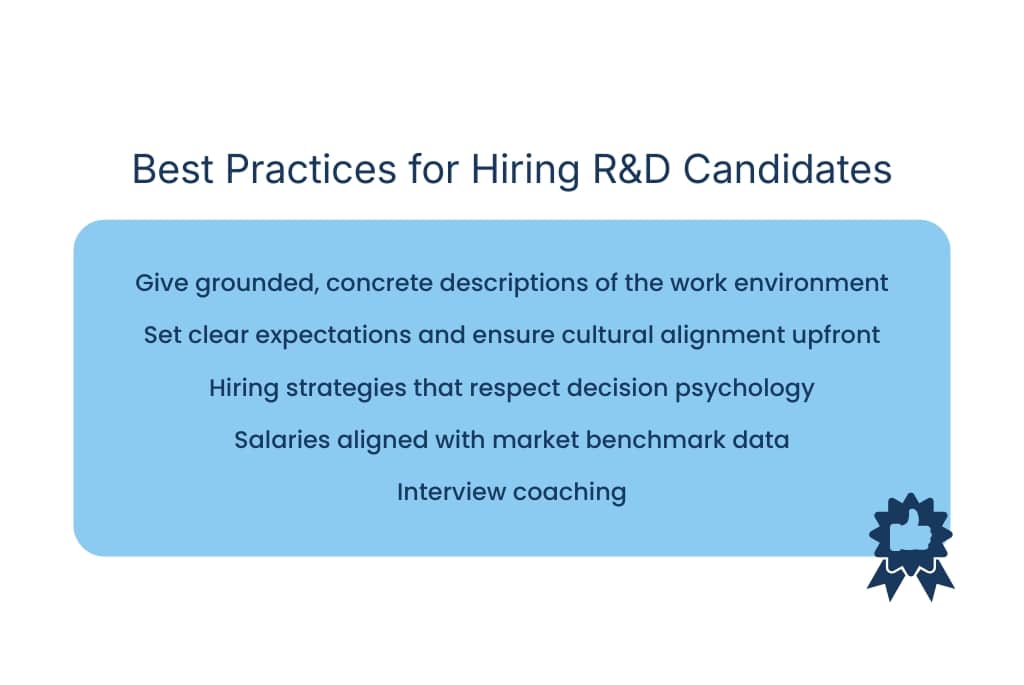
R&D professionals are skeptical of polished narratives. They respond better to grounded, concrete descriptions of the work environment. This includes constraints, tradeoffs, and how decisions are made.
Effective recruiters do not oversell innovation. They describe how ideas move from concept to execution, where friction appears, and how leadership responds when experiments fail. That transparency creates emotional safety, which accelerates decision-making.
Alignment Requires Two-Way Translation
Recruiters play a translation role between emotionally driven candidates and outcome-driven hiring managers. This goes beyond scheduling interviews.
On the candidate side, recruiters surface non-negotiables early. On the company side, they clarify what flexibility exists and where it does not. When this translation happens early, fewer assumptions survive into the offer stage.
Coaching R&D Candidates on Formal Interviewing
Strong Scientists Are Often Weak Interviewers
Many high-performing R&D professionals struggle with formal interviews. They explain work in technical depth but fail to contextualize impact. They may undersell leadership contributions or avoid discussing conflict.
This is not a skills gap. It is a communication mismatch. Structured interview formats favor concise narratives, not exploratory thinking. Without coaching, capable candidates appear misaligned, indecisive or nervous.
These candidates often need to be coached to quickly articulate their accomplishments without overcommunicating out of nervousness.
Coaching Reduces Misinterpretation on Both Sides
Effective coaching focuses on translation, not scripting. Candidates learn how to connect experiments to outcomes, failures to learning, and autonomy to accountability.
This process also helps candidates clarify their own priorities. By articulating what success looks like, they self-screen more effectively. That reduces late withdrawals driven by second thoughts.
Why Compensation Alignment Must Happen Earlier
Market Awareness Reduces Emotional Risk
Compensation uncertainty introduces emotional friction. Candidates who are unsure whether an offer reflects market reality hesitate, even when excited about the role.
Engaging candidates in compensation benchmarking early stabilizes expectations. Public data sources provide sufficient grounding without turning negotiations adversarial.
The U.S. Bureau of Labor Statistics provides detailed wage data across R&D-related occupations, including life sciences, chemical engineering, and materials science.
These benchmarks should also be compared to the candidate’s current financial situation. At The Richmond Group USA, we give our candidates a compensation survey in order to get the full picture of their financial situation including salary, benefits, stock options and bonuses. Getting a full understanding of the situation allows candidates to compare options with confidence.
Financial Alignment Is Part of Psychological Safety
Late-stage renegotiation often signals unresolved anxiety rather than greed. When compensation conversations are delayed, candidates fill gaps with assumptions.
Recent placements show that candidates who reviewed market ranges before final interviews were less likely to counter aggressively or delay acceptance. Alignment earlier reduces emotional risk later.
The Often-Ignored Role of Family and Social Validation
R&D Decisions Rarely Happen in Isolation
R&D professionals tend to consult trusted circles before making career moves. Family members, mentors, and former colleagues influence decisions, especially when relocation or schedule changes are involved.
Encouraging candidates to have these conversations early prevents last-minute reversals. This is not interference. It is realism.
The American Psychological Association notes that emotional support is a protective factor when people face stressful life difficulties. For candidates weighing a major job change, engaging a support network early often reduces stress and prevents last-minute second-guessing.
Silence Creates Space for Doubt
When candidates delay discussing offers with their inner circle until the final stage, doubts surface under time pressure. That leads to hesitation or withdrawal.
Recruiters who normalize these conversations early help candidates move faster later. The process feels deliberate instead of rushed.
What Stronger R&D Teams Share in Common
Fewer Surprises Late in the Process
High-retention R&D teams invest time upfront. They clarify expectations around autonomy, documentation burden, decision authority, and resource access. Candidates know what they are walking into.
This reduces cognitive dissonance after acceptance. New hires onboard faster and disengage less.
Hiring Strategies That Respect Decision Psychology
Organizations that adjust hiring strategies to account for kinesthetic decision-making see measurable improvements. Offers close faster. Counteroffers decline. Early turnover drops.
This does not require longer processes, but rather better sequencing.
Analysis from the National Academies of Sciences, Engineering, and Medicine emphasizes that clear team structures, defined roles, and intentional practices in scientific teams are linked with better project outcomes and measurable collaborative performance. Evidence from the Academies’ The Science and Practice of Team Science report shows that when roles and expectations are aligned within research teams, teams are better positioned to achieve their goals and assess their performance over time.
Forward-Looking Observations for R&D Hiring
Emotional Alignment Will Matter More as Technical Skills Commoditize
As technical skills become more standardized through shared platforms and tools, differentiation shifts toward environment and leadership. Candidates will increasingly choose where they feel effective rather than where they look impressive.
Recruiters who ignore emotional drivers will lose candidates to quieter competitors who communicate better.
Data Transparency Will Replace Negotiation Theater
Public compensation data and peer networks are reducing information asymmetry. Candidates expect transparency earlier. Organizations that resist will see prolonged negotiations and higher dropout rates.
This shift favors companies willing to anchor offers in market reality rather than internal precedent.
How The Richmond Group USA Applies These Lessons
The Richmond Group USA approaches R&D hiring as an alignment exercise, not a transaction. Recent placements reflect a disciplined focus on decision psychology, market clarity, and candidate preparation.
By coaching candidates on communication, grounding compensation discussions in public data, and encouraging early personal alignment, late-stage attrition drops. Hiring managers gain predictability. Candidates gain confidence.
Stronger R&D teams form when hiring strategies respect how scientists and engineers think and make decisions.
Need help hiring for your next R&D role? Reach out to our Life Sciences Division to learn more about the recruitment services offered by The Richmond Group USA.
Shawn Barley
President, Life Sciences Division
shawnb@richgroupusa.com
LinkedIn