
How Long Does it Take to Hire an Executive? Benchmark Timelines by Industry
Introduction
Leadership turnover has accelerated across many industries. Retirements are rising, private equity ownership continues to expand, and boards are replacing executives quicker when their performance doesn’t live up to the board’s standards.
This raises a question for organizations: When a senior leader leaves or a new executive role opens, how long will it actually take to hire the replacement?
The answer depends heavily on the industry. Hiring timelines vary dramatically between sectors with large labor pools and those that depend on highly specialized expertise.
Leadership hiring adds another layer of complexity. Executive roles require a smaller pool of candidates, more stakeholder involvement, and deeper evaluation. The result is a hiring timeline that often stretches far beyond the industry average.
Understanding how industry hiring timelines and executive search timelines intersect gives hiring leaders a more realistic view of how long leadership transitions actually take.
Table of Contents
How Long Does an Executive Search Take?
Most executive searches take 3-6 months from role definition to offer acceptance. CEO and board-level roles often require 4-8 months, particularly in industries with specialized leadership pipelines.
Executive hiring takes longer than standard recruiting for several reasons. Candidates are usually passive rather than actively applying for jobs. Hiring decisions involve boards, investors, and senior leadership teams. And the evaluation process focuses on long-term leadership impact rather than immediate technical skills.
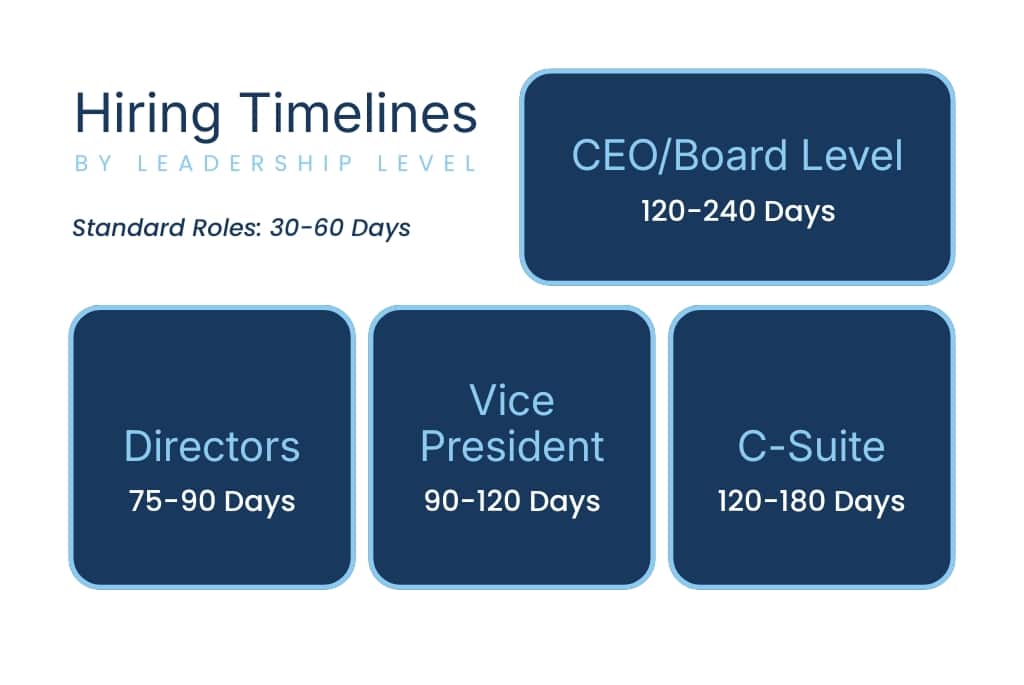
Executive Search Timeline Summary by Role
| Search Type | Typical Timeline |
| Standard Corporate Role | 30–60 days |
| Director-Level Role | 75–90 days |
| Vice President | 90–120 days |
| C-Suite Executive | 120–180 days |
| CEO Or Board-Level Search | 4–8 months |
For comparison, the Society for Human Resource Management reports that the average time to fill across all non-executive roles is roughly 52 days, compared to an average of 62 days for executive positions.
Time to Fill vs Time to Hire
Hiring timelines often get discussed using two closely related metrics.
Time to Fill
Time to fill measures the number of days between opening a job requisition and accepting an offer. This metric captures the entire hiring process including sourcing candidates, conducting interviews, and negotiating offers.
Time to Hire
Time to hire measures the number of days between a candidate entering the hiring pipeline and accepting an offer. The difference matters for executive hiring because identifying potential candidates often takes weeks before the interview process begins.
Average Time to Fill Roles by Industry
Hiring timelines vary widely depending on the industry. Some sectors fill positions in a few weeks while others routinely take two months or more.
Industry benchmarks offer one of the clearest ways to set realistic expectations for hiring timelines. Research comparing hiring data across sectors shows that the average hiring process ranges from about two weeks in service industries to nearly two months in specialized technical fields.
The variation reflects structural factors such as:
- Labor supply
- Regulatory requirements
- Certification or licensing needs
- Geographic concentration of talent.
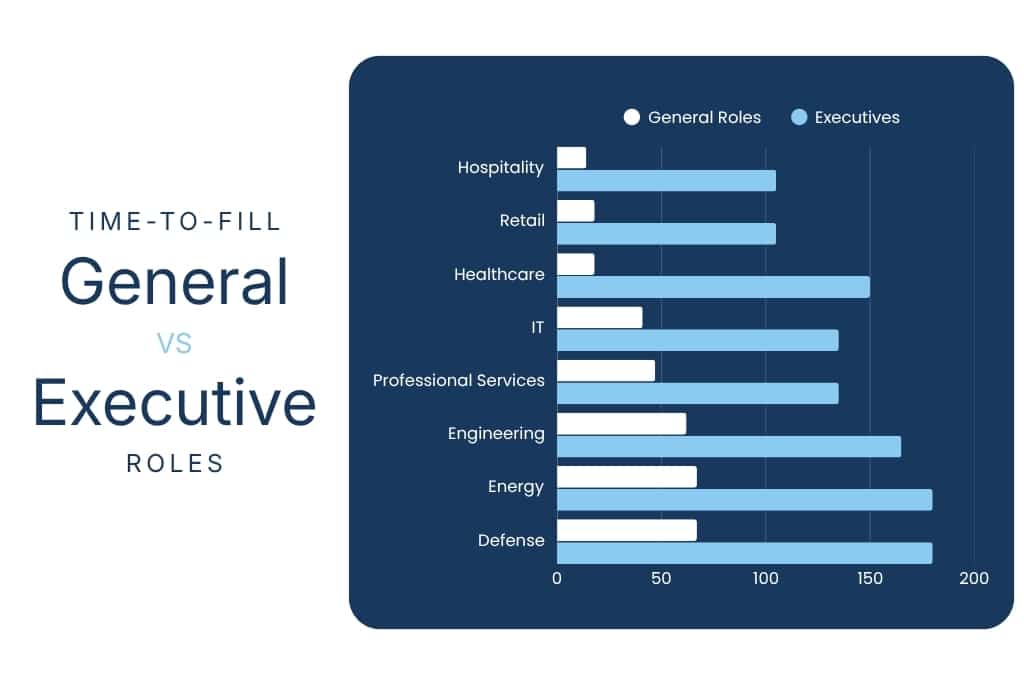
Time to Fill Roles by Industry
| Industry | Average Time To Fill (Days) |
| Cleaning Services | 14 |
| Hospitality | 14 |
| Automotive | 16 |
| Home & Commercial Services | 17 |
| Personal Care | 17 |
| Education & Child Care | 18 |
| Healthcare | 18 |
| Restaurant & Food Service | 18 |
| Retail | 18 |
| Tech & Media | 20 |
| Fitness | 22 |
| Information Technology | 41 |
| Professional Services | 47 |
| Investment Banking | 60 |
| Engineering | 62 |
| Energy & Defense | 67 |
These numbers represent averages across all roles. Executive hiring follows the same industry pattern but stretches significantly longer because the candidate pool narrows as seniority increases.
Executive Search Timeline by Industry
Leadership searches reflect the same industry dynamics seen in general hiring, but the timelines expand.
Executive roles involve passive candidates, longer interview cycles, and extensive stakeholder participation. As a result, leadership searches often take 2-3x longer than the average hiring timeline in that industry.
Estimated Executive Search Timeline by Industry
| Industry | Typical Executive Search Timeline |
| Hospitality | 3–4 months |
| Retail | 3–4 months |
| Personal Services | 3–4 months |
| Healthcare | 4–6 months |
| Information Technology | 4–5 months |
| Professional Services | 4–5 months |
| Financial Services | 4–6 months |
| Engineering | 5–6 months |
| Energy | 5–7 months |
| Defense | 5–7 months |
Industries with highly specialized expertise and regulatory oversight often experience the longest leadership searches.
Healthcare leadership roles illustrate this dynamic. Hospitals and life sciences companies often require executives with operational experience and deep regulatory knowledge. That combination significantly reduces the number of viable candidates.
Engineering-heavy industries face a similar challenge. Many senior leaders build their careers within a small set of companies, which means organizations searching for executives may be competing for the same limited pool of candidates.
Why Executive Searches Take Longer Than Standard Hiring
Passive Candidate Sourcing
Senior executives rarely apply for roles directly. Most leadership searches begin with targeted outreach rather than inbound applications.
Recruiters and hiring leaders must identify potential candidates, establish contact, and determine whether those individuals are open to considering a new role.
Multi-Stakeholder Decision Making
Executive hires rarely belong to a single hiring manager. Boards, investors, senior leadership teams, and HR leaders often participate in the evaluation process. Coordinating interviews across those groups can extend the timeline.
Strategic Leadership Evaluation
Companies are doing more than evaluating technical competence. They’re evaluating leadership philosophy, long-term strategic thinking, and cultural impact.
Typical Stages of an Executive Search Timeline
Executive hiring usually unfolds in several phases.
| Stage | Typical Duration |
| Role Definition & Search Strategy | 2–3 weeks |
| Candidate Sourcing & Outreach | 4–6 weeks |
| Interviews & Evaluation | 4–8 weeks |
| References & Due Diligence | 2–3 weeks |
| Offer Negotiation & Acceptance | 2–4 weeks |
Even when the process moves smoothly, these stages typically add up to 3-6 months.
Another factor that often extends leadership hiring timelines involves executive notice periods. Senior leaders frequently remain with their current employer for several months after accepting a new role to ensure a smooth transition.
Planning Leadership Searches Earlier Than Most Companies Do
Executive hiring timelines create a strategic challenge for organizations.
Many companies begin leadership searches only after an executive departs. That approach leaves little margin for a process that may take 6+ months. When a CEO retires unexpectedly or a senior leader resigns, the organization often scrambles to define the role, identify candidates, and coordinate a search. The delay can leave critical decisions in limbo.
Forward-looking organizations treat leadership hiring differently. They prepare for it well before the role becomes vacant. This is where business succession planning plays an important role.
Succession planning focuses on identifying and developing future leaders inside the organization while also maintaining visibility into external talent markets. Instead of reacting to a leadership gap, companies build a pipeline of potential candidates who could step into key roles.
Effective succession planning typically involves several practices:
- Identifying critical leadership positions and the skills required to succeed in them
- Assessing internal managers who could potentially move into those roles over time
- Providing leadership development and cross-functional experience to prepare those candidates
- Maintaining awareness of external executives who could step in if internal succession is not feasible.
The approach reduces the disruption that often follows executive departures. If a senior operations leader leaves unexpectedly, the company may already have a director or vice president prepared to step into the role on an interim basis.
Succession planning also shortens executive search timelines. When companies understand the capabilities they need and already know several potential candidates, the search process becomes more focused.
Companies that invest in succession planning often discover that executive hiring becomes less reactive. Instead of rushing to fill a vacancy, leadership transitions can be planned months or even years in advance to reduce the impact of an executive departure.
Executive Search Timeline FAQ
How Long Does It Take to Hire an Executive?
Most executive searches take 3-6 months, though CEO and board-level roles often require 4-8 months depending on industry specialization.
Which Industries Take the Longest to Hire In?
Industries such as engineering, energy, defense, and financial services tend to have longer hiring timelines due to specialized expertise and smaller talent pools.
Why Do Executive Searches Take Longer Than Other Roles?
Executive hiring requires sourcing passive candidates, coordinating interviews among multiple stakeholders, and conducting extensive due diligence before extending an offer.
Conclusion
Hiring timelines vary far more by industry than many organizations realize.
Service industries may fill roles in two weeks. Engineering and energy companies may take two months or longer. Executive hiring expands those timelines even further.
Leadership searches combine industry talent shortages with complex decision-making processes. The result is a hiring timeline that often stretches several months.
Organizations that understand these dynamics can plan leadership transitions more effectively and avoid the disruption that comes from prolonged vacancies.
If you’re looking to replace an executive or begin succession planning, The Richmond Group USA can help you get your search started. We specialize in executive searches for manufacturing, banking, life sciences and more. Reach out to our team today to start the conversation!