
Technical Sales Executive Hiring: 5 Obstacles Killing Your Search
You’ve posted the job for eight weeks. Eighty-three applications later, you’ve conducted six phone screens and not one candidate can explain how your product integrates with enterprise systems while also articulating a coherent sales strategy.
If hiring a technical sales executive feels impossible, there’s a reason. You need someone who can walk into a CTO’s office and discuss API architecture, then turn around and negotiate a six-figure deal with a CFO. That combination doesn’t grow on trees.
Here’s what you’ll learn: why the technical sales executive market is uniquely challenging right now, the specific obstacles derailing most searches, concrete strategies to improve your odds, and when specialized recruitment support makes sense.
Table of Contents
The Technical Sales Executive Market Right Now
The market for technical sales executives is a seller’s market where qualified candidates have options.
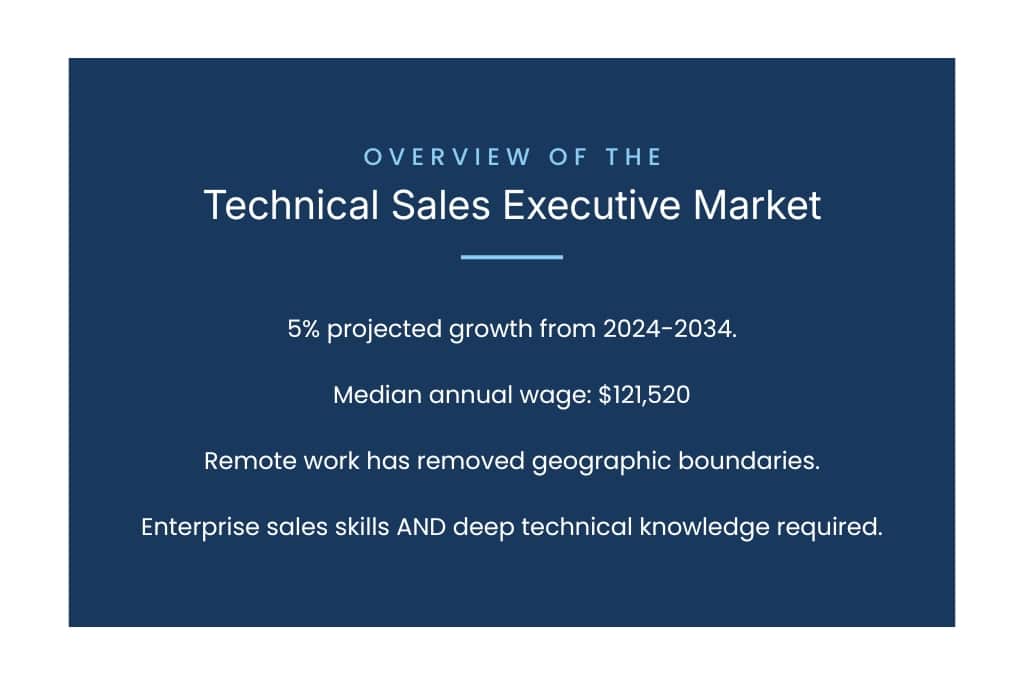
According to the U.S. Bureau of Labor Statistics, employment of sales engineers is projected to grow 5% from 2024 to 2034, faster than the average for all occupations. While overall sales occupations are declining, technical sales roles are expanding. That growing demand is crashing into a limited talent pool.
Remote work erased geographic boundaries. You’re competing with firms in San Francisco, New York, Austin, and everywhere in between. Products are getting more complex. Today’s buyers expect your sales executive to answer detailed questions about architecture, integration, and security protocols, not just redirect to engineering.
The skill combination is inherently rare. You need someone who spent years developing deep technical knowledge AND separately developed enterprise sales skills. Most people build one or the other, not both.
How Competitive Is the Technical Sales Executive Market?
The median annual wage for sales engineers was $121,520 in May 2024, with the highest 10% earning more than $202,670. Those numbers reflect what companies are willing to pay. If your compensation package isn’t in that range, you’re already at a disadvantage.
Why Technical Sales Executives Are Different from Regular Salespeople
You can’t just hire a great salesperson and teach them the technical stuff. And you can’t hire a brilliant engineer and expect them to close deals.
The Skill Intersection Problem
A technical sales executive operates in three different modes:
Technical credibility. They need to understand your product architecture well enough to have substantive conversations with CTOs and engineering teams. When a prospect asks how your API handles authentication or what happens during a failover scenario, your sales executive needs to provide accurate, detailed answers.
Sales execution. They also need to prospect effectively, build relationships, navigate complex enterprise sales cycles, negotiate contracts, and close deals. Plenty of engineers can explain how something works but freeze when it’s time to ask for the business.
Executive presence. Your technical sales executive often engages with C-suite buyers who care about business outcomes, ROI, and strategic value. They need to switch contexts seamlessly from a technical deep-dive with engineers to a business-focused conversation with a CFO.
Most people develop one, maybe two of these capabilities. Finding someone strong in all three is legitimately difficult.
The Compensation Complexity
Technical sales executives command compensation that reflects BOTH their technical expertise AND their sales ability. That means a competitive base salary (often higher than traditional sales roles) plus a commission structure that rewards performance.
Many companies underprice one component or both. They offer a sales-level base salary and wonder why they can’t attract candidates with serious technical credentials. Or they offer tech-level comp without the commission upside. Either way, they lose candidates.
The Five Biggest Obstacles in Hiring Technical Sales Executives
1. Your Job Description Asks for Unicorns
Your job posting wants someone with ten years of enterprise software sales, five years as a solutions engineer, expertise in three technical domains, and proven Fortune 500 success.
You just eliminated 99.5% of potentially good candidates.
Every “required” qualification you add cuts your available candidates roughly in half. What actually matters? Can they understand and explain technical products? Can they run an enterprise sales process? Do they have executive presence? Everything else is negotiable.
2. You’re Fishing in a Shallow Pond
Most companies post on LinkedIn, post on Indeed, and hope their network refers someone.
The best technical sales executives aren’t browsing job boards. They’re employed, performing well, and getting recruited weekly. Your job posting strategy only reaches active job seekers which is a fraction of the available talent market.
3. Your Interview Process Loses Candidates
Research shows nearly 40% of senior-level roles need more than 90 days to fill. Your six-round interview process with two-week gaps between each conversation might feel thorough but to candidates, it signals indecision.
Top technical sales executives are evaluating multiple opportunities simultaneously. While you’re scheduling the fourth round, your competitor made an offer.
4. You Can’t Properly Assess Technical Credibility
Your VP of Sales knows what good selling looks like but can’t evaluate database architecture knowledge. Your CTO can assess technical knowledge but doesn’t know what separates solid sales skills from mediocre ones.
This creates two failures: you hire someone who talks a good technical game but lacks depth, or you reject strong candidates because your sales leader didn’t recognize their technical capabilities.
5. Compensation Misalignment Kills Deals
You’ve found the perfect candidate. Everyone loves them. Then you extend an offer at $130,000 base plus commission, and they politely decline.
What you didn’t know: they’re currently making a $155,000 base with commission that puts total comp around $220,000. Your “generous” offer represents a significant pay cut.
Compensation research needs to happen before you post the job, not after you’ve fallen in love with a candidate.
What You Can Do to Improve Your Technical Sales Hiring
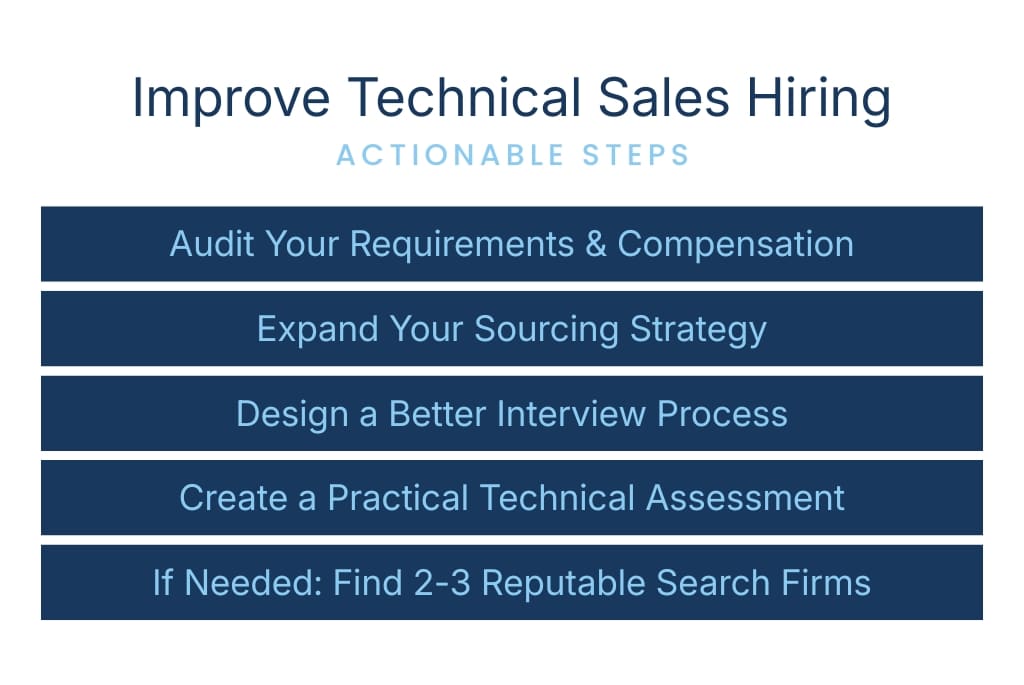
Audit Your Requirements and Compensation
Take out your job description right now. For every qualification listed as “required,” ask: would we reject an otherwise excellent candidate who lacked this specific thing?
If the answer is no, it’s not required. Move it to preferred or delete it.
Then research actual market compensation. The Bureau of Labor Statistics shows sales engineers in the top 10% earning more than $202,670 annually, and that’s before commission. Build a compensation package that competes.
You can do this today: Open your job description and cross out every “required” qualification that isn’t genuinely non-negotiable. Research compensation ranges on the BLS website.
Expand Your Sourcing Strategy
Job postings are fine for active candidates, but you need to reach passive ones too.
Where do technical sales professionals spend time? Industry conferences, online communities, LinkedIn groups focused on their specialty. Start building relationships there before you desperately need someone.
Consider adjacent talent. Engineers who’ve expressed interest in customer-facing roles. Sales professionals who’ve successfully sold technical products. Someone with 80% of what you need and clear capacity to learn the other 20% is often better than holding out for perfection.
Design a Better Interview Process
Map out every step of your current process. How many interviews? How much time is there between each stage?
Now cut the calendar time in half. Schedule multiple interviews in the same day or consecutive days. Get stakeholder alignment upfront on what you’re looking for.
Create clear evaluation criteria before you start interviewing. When everyone’s evaluating against the same rubric, decisions get made faster.
Create a Technical Assessment That Works
Partner your sales leader with someone from your technical team to co-develop the assessment. Not a written test. A practical scenario.
Example: “Walk us through how you’d approach selling our product to a company that currently uses [competitor]. What questions would you ask their technical team? What objections do you anticipate?”
This tests technical understanding, sales strategy, and communication simultaneously. The assessment should evaluate communication ability as much as technical knowledge since that’s what they’ll need to do with prospects.
When Executive Search Firms Make Sense for Technical Sales Roles
Not every search requires outside help. But certain situations benefit from specialized recruitment expertise.
What Specialized Recruiters Bring to the Table
Executive search firms focused on technical sales recruitment maintain relationships with candidates who aren’t actively looking but would consider the right opportunity. They can reach out to someone employed at your competitor without putting you in an awkward position.
Good recruiters bring assessment capabilities. They’ve interviewed hundreds of technical sales candidates and know how to evaluate both skill sets effectively. Speed is another advantage. Recruiting is their full-time job and all their time can be spent on the search.
The ROI Calculation
According to SHRM data, each unfilled position costs companies an average of $4,129 over a 42-day vacancy period. And the cost for revenue-generating roles can reach $7,000 to $10,000 per month
If your territory sits vacant for 90 days, you’re looking at $21,000 to $30,000 in opportunity cost. That doesn’t account for deals that don’t happen or competitive ground you lose.
Executive search fees typically run 20-30% of first-year compensation. For a $180,000 role, that’s $36,000 to $54,000. Compare that to three months of vacancy cost plus the risk of a bad hire who underperforms for six months before you acknowledge the problem.
What To Look for In a Technical Sales Recruiter
Not all recruiters understand technical sales. What you want is someone who specializes in technical sales or sales engineering recruitment.
Questions to ask: How many technical sales executives have you placed in the past year? What’s your process for assessing technical credibility? Can you describe the difference between solutions engineering and technical sales executive roles?
Red flags: recruiters who spray resumes without understanding your needs, firms that can’t articulate how they assess both capabilities, anyone who promises unrealistic timelines.
Your Next Steps in Finding Technical Sales Talent
Today or this week:
- Audit your job description. Eliminate requirements that aren’t genuinely non-negotiable.
- Research market compensation using BLS data.
- Map your interview process and identify bottlenecks.
This month:
- Rebuild your sourcing strategy beyond job boards.
- Create a scenario-based assessment with input from both technical and sales teams.
- If you’ve been searching for 60+ days without qualified candidates, evaluate 2-3 specialized search firms.
Build a pipeline mindset: Don’t wait until you desperately need someone. The best hiring happens when you’re building relationships continuously. Attend industry events. Contribute to professional communities. When you need to hire quickly, you’re operating from desperation. When you’ve built a pipeline, you’re operating from strength.
The Cost of Getting This Wrong
Hiring a technical sales executive isn’t like hiring a junior account executive. This person will own major accounts and directly impact revenue.
The technical sales executive hiring market is objectively challenging. The skill intersection you need is genuinely rare but understanding why it’s hard gives you a roadmap for what to do differently.
If you’ve been running the same search for months without success, it’s time to change your approach. That might mean fixing your job description, accelerating your process, expanding your sourcing, or bringing in specialized recruitment expertise.
Your next technical sales executive is out there. The question is whether your hiring approach is sophisticated enough to find them, assess them accurately, and move fast enough to secure them before someone else does.
If you’re looking for help hiring your next technical sales executive, talk to our specialist Terri Kubicki about your company’s needs!
Terri Kubicki
Director, Equipment Sales Division
(804) 404-2804
terrik@richgroupusa.com