

Executive Hiring 101: Retained vs. Contingency Search Models
When your organization is ready to bring in top-level talent, especially leadership or other critical roles, the method you use to search can make all the difference. In this post, we’ll dive into retained vs contingency search; what each means, when they work best, and how to decide which fits your hiring needs.
Whether you’re a growing firm scaling up, or an established player looking for strategic leaders, this guide can help you make a smart, data-driven choice.
Table of Contents
What Are “Executive Search” Models (And Why They Matter)
The term “executive search” refers broadly to recruiting practices aimed at senior leadership positions, specialized roles, or other high-stakes hires. In executive search, the stakes are high; not just because of salary levels, but because these roles often influence company culture, strategic direction, and long-term success.
Within executive search, two main models dominate: a retained search and a contingency search. While both are common, they’re built on different philosophies, payment structures, and levels of commitment. Understanding these differences can save your company time, money, and headaches down the road.
Retained Search: A Strategic, High-Commitment Approach
What Is Retained Search?
A retained search is an exclusive, partnership-based approach. When you engage with a firm for a retained search, you commit to working exclusively with that firm for a defined role. As a sign of this commitment, a retainer fee is paid upfront which ensures your search becomes a top priority backed by a higher level of focus, accountability, and commitment to delivering.
Why Companies Use Retained Search
- Highest Level of Commitment: A retained firm is financially engaged from the start, which means your search receives dedicated time, focus, and accountability until the right hire is made.
- Priority Treatment: Because the firm is retained, your role is treated as a top priority, and not one of many competing contingent searches
- Brand Protection & Confidentiality: Retained firms represent your company professionally and consistently, controlling the message and protecting confidentiality when needed.
- Higher Quality, Not Higher Volume: The focus shifts from speed-of-submission to precision, ensuring only the strongest, most relevant candidates reach your desk.
Expected Results with Retained Search
One major advantage of using a retained search model is that your search team is dedicated to prioritizing your search. Since your search is being made a priority, retained searches can often result in faster placement for the role than you would see with a contingent search.
In addition, our team will make it a priority to consult with you more frequently to ensure that you receive progress updates and any information that may be relevant to your search. Extra care is taken to ensure that you are updated with market insights like compensation surveys and market analysis to ensure your offer is competitive and attractive to the candidates that are being presented to you.
By placing a priority on your search, we are able to improve communication and cut down the time-to-hire for each open role. These benefits lead to improved quality of hire, a better candidate experience, and better long-term outcomes from each hire.
Better Long-Term Hiring Outcomes
Research from the U.S. Bureau of Labor Statistics shows that replacement hires carry significantly higher turnover risk than hires sourced through proactive recruitment or targeted headhunting. Specifically, BLS data indicates that voluntary quit rates are highest among workers who are recruited through open postings rather than direct outreach.
Retained search relies primarily on direct outreach to passive candidates, who have historically lower turnover rates, meaning companies typically experience higher retention when roles are filled through targeted, relationship-based recruitment.
Time-to-Fill for Executive Roles
For many executive-level jobs, anecdotal and broader-market data suggest an average time-to-fill in the 90–150 day range (or roughly 3 to 5 months); this aligns with the fact that senior roles typically require deeper vetting, more stakeholders, and more negotiation time.
Why this matters: retained search models are specifically designed for these longer, more complex searches by dedicating senior-level recruiters, structured processes, and market mapping; increasing the likelihood of a successful placement even in difficult talent markets.
Quality of Hire & Business Impact
A study by the Harvard Business School and Accenture found that companies who fill critical roles through proactive, skills-aligned sourcing (instead of general applicant pools) report up to 20% higher productivity and stronger job performance outcomes.
Why These Metrics Matter
These external data points reinforce a key reality:
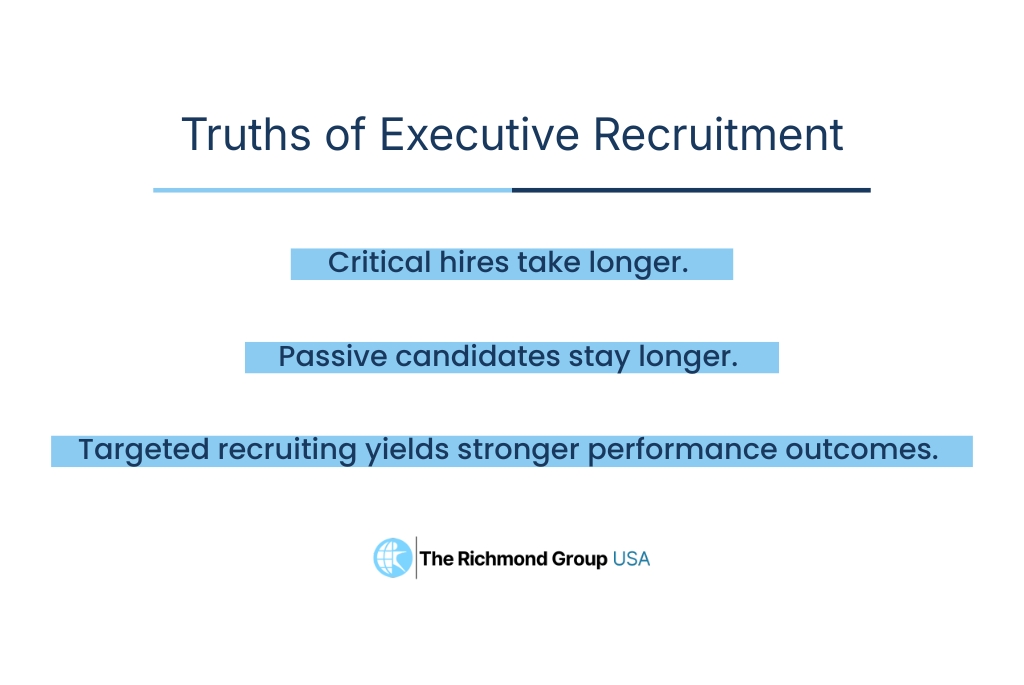
- Critical hires take longer.
- Passive candidates stay longer.
- Targeted recruiting yields stronger performance outcomes.
Retained search models are specifically engineered to support these truths, which is why organizations often choose them for executive search and high-impact positions.
Contingency Search: A Speed-Focused, Cost-Sensitive Option
What Is Contingency Search?
In a contingency search, the firm only gets paid if they successfully place a candidate. There’s no upfront fee. Essentially, payment is “contingent” on a hire.
Because there’s no guarantee of payment, contingency recruiters often juggle multiple searches and clients at once. This model tends to cast a wide net, relying heavily on active job seekers and larger applicant pools.
Why Companies Use Contingency Search
- Lower risk upfront: Since you don’t pay until a hire lands, there’s minimal cost if the search fails or gets abandoned.
- Speed (especially for mid-level or volume hiring): Contingency works well for rapidly filling multiple roles or positions that don’t require highly specialized skills.
- Cost-conscious hiring: For companies with tighter budgets or roles with less seniority, contingency may feel more financially pragmatic than a heavy upfront investment.
But There Are Tradeoffs
Because contingency recruiters may have less incentive to invest time on unique or difficult-to-fill roles, success rates tend to be lower. Some data suggests contingency search completion rates hover around 20–35%.
Further, contingency searches often focus on active candidates only (those already looking for jobs) which may exclude many of the top-performing passive candidates.
Finally, the vetting process may be less rigorous, leading to greater risk of mis-hire, turnover, or poor fit in leadership or specialized roles.
The Hidden Cost: What Happens When Hiring Goes Wrong
Before you decide which search model to use, it’s important to understand what’s at stake if you make a bad hire; especially in roles that impact strategy or company performance.
- According to the U.S. Department of Labor, a bad hire can cost as much as 30% of an employee’s first-year earnings.
- Broad estimates show that the total cost of a bad hire( including recruiting, onboarding, lost productivity, managerial oversight, and turnover) can reach tens of thousands of dollars per mis-hire.
Even beyond dollars, bad hires can degrade morale, distract management (some report spending up to 17% of their time supervising underperforming staff), and damage team cohesion.
When you consider these risks, especially at senior or specialized roles, investing in an effective, high-quality executive search process is about protecting long-term performance and culture.
That’s why for critical hires, many companies see a retained search as an investment, not an expense.
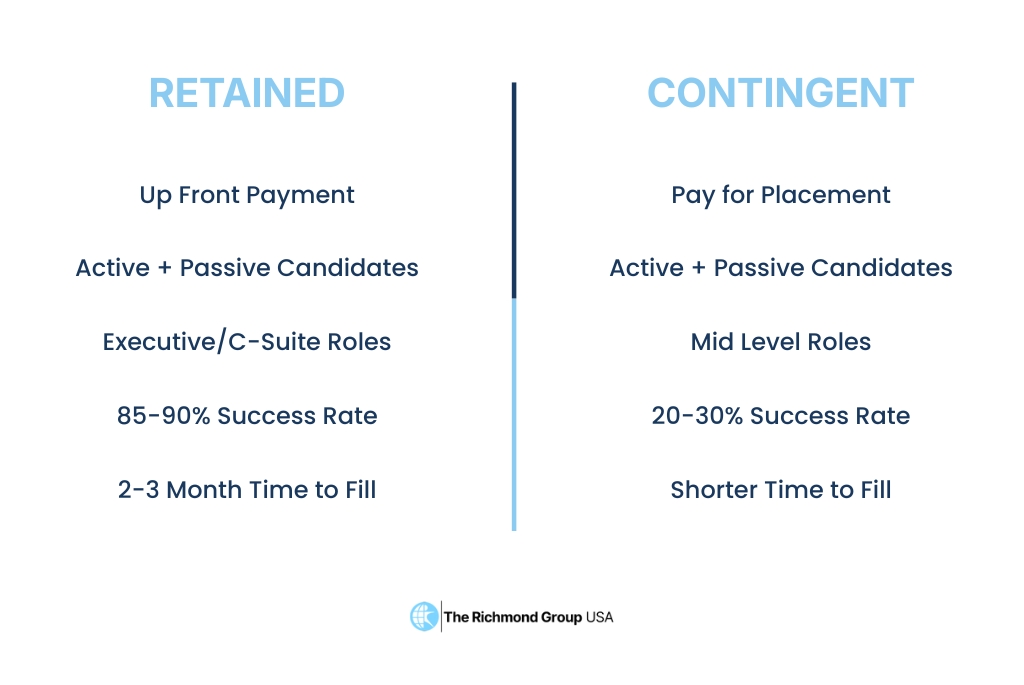
Insider Comparison: Retained vs Contingency Search
| Feature / Metric | Retained Search | Contingency Search |
| Payment Model | Up-front retainer (plus installments) | Payment only after placement: “pay-for-success” |
| Exclusivity | Exclusive: recruiter works only for you | Non-exclusive: recruiter may juggle multiple clients |
| Candidate Pool | Active + passive (head-hunted), broader network | Primarily active job-seekers |
| Vetting Depth | In-depth: interviews, reference checks, fit & culture assessment | Lighter vetting: often quick resume screening & reactive outreach |
| Roles Best Suited For | Executive, C-suite, specialized senior roles, critical hires | Mid-level roles, volume hiring, less specialized positions |
| Success / Completion Rate* | ~ 85 – 95% | ~ 20 – 35% |
| Time-to-Fill | Usually longer (often 2–3 months, sometimes more) | Often faster (especially for straightforward roles) |
| Upfront Cost to Employer | High (retainer and possible structured payments) | Low or none until placement |
* “Success rate” refers to the portion of searches that lead to placement, not long-term retention. A higher completion rate tends to correlate with better fit and lower risk of turnover in executive hiring contexts.
When Should Your Company Choose Retained vs Contingency Search?
Given what we’ve laid out, here’s how to think about which model works for you.
Choose Retained Search If:
- You’re filling a strategic, senior-level, or highly specialized role (C-suite, technical leadership, niche skill set).
- The position requires confidentiality, sensitivity, or discretion.
- Long-term fit, cultural alignment, and leadership vision are top priorities.
- You want access to passive candidates who won’t apply via standard job boards.
- You understand the value of investing in quality over speed because a bad hire may cost far more than the retainer fee.
Choose Contingency Search If:
- You need to fill multiple or mid-level roles quickly (volume hiring), especially roles with standard or replaceable skill sets.
- Your hiring budget is limited or you want to minimize upfront costs.
- Time-to-hire is the top constraint and thorough vetting is less critical.
- The role is less strategic or doesn’t dramatically impact long-term culture or organizational direction.
Consider a Hybrid Approach
Many companies find value in combining both models; for example, using contingency firms for volume hiring of mid-level staff, while engaging a retained partner for leadership or critical hires. This hybrid approach can maximize speed and cost-efficiency when appropriate, while still protecting long-term organizational health for key roles.
Why For Some Roles, Retained vs Contingency Search Isn’t Just a Cost Decision; It’s a Risk Mitigation Strategy
Here’s a scenario that illustrates why choosing the right search model is more than a matter of budget or speed; it’s about risk, culture, and long-term organizational health:
Imagine you need a new CFO or VP in a high-growth company. The person you hire will influence financial strategy, investor relations, and even company culture. A mis-hire could:
- Hurt morale across the leadership team
- Drain resources through turnover, retraining, and re-hiring
- Damage reputation with investors or clients
- Interrupt strategic initiatives, delaying growth
Considering that a bad hire can cost up to 30% of that employee’s first-year earnings, plus opportunity costs (lost deals, disrupted strategy, poor culture fit), the cost of picking the wrong person can easily outweigh the fee for a retained search.
In other words: for critical hires, the question isn’t “Can we afford a retained search?” but rather “Can we afford not to?”
Final Thoughts: The Right Tool for the Right Role
In the debate of retained vs contingency search, there’s no one-size-fits-all answer. What matters most is the nature of the role, the priorities of the company, and the long-term implications of the hire.
- If you want speed, flexibility, and lower upfront cost, contingency can work for many roles.
- If you’re hiring at the executive or senior-leader level, targeting passive talent, want confidentiality, or care deeply about long-term fit and success, retained search is often the smarter investment.
At the end of the day, a good executive search isn’t a cost; it’s a strategic investment in your company’s future.
To learn more about the executive search methods used by The Richmond Group USA, reach out to our team to discuss your options.


