
How to Build Effective Executive Recruiting Strategies in 2026
Hiring executives in 2026 can feel weirdly hard.
There are still a lot of open jobs, but fewer people are confidently jumping to a new company. For example, the U.S. government’s JOLTS report for October 2025 showed 7.7 million job openings, about 5.1 million hires, and a 1.8% quits rate. These are signs that many workers (including leaders) are staying put unless the move is clearly worth it.
So, what’s the play?
You win executive talent with a better process. Not a longer job description. Not more interview rounds. A clearer plan.
Below is a simple, practical guide you can use to build stronger executive recruiting strategies in 2026 plus a straightforward hiring strategy plan you can reuse for future leadership roles.
We also show where The Richmond Group USA can help when the role is high stakes, confidential, or hard to fill.
Start with Results You Need (Not a Long Job Description)
Most companies start an executive search by writing a job description.
That’s fine. But it’s not enough.
Instead, start with a one-page “results sheet” that answers:
- Why does this role exist?
- What must this leader deliver in the next 6-18 months?
- What skills do they need in order to deliver that?
- What are the true deal-breakers (travel, location, certifications, etc.)?
This matters because work is changing fast. The World Economic Forum says employers expect 39% of workers’ core skills to change by 2030.
In plain English: if you hire based only on “years of experience,” you’ll miss people who can actually drive outcomes.
Examples of results you may need:
- “Cut downtime by 15% within 12 months”
- “Build a leadership bench for two new sites by Q4”
- “Fix forecasting accuracy and reduce inventory swings”
This simple shift is one of the most effective executive recruiting strategies out there.
Clarify How the Executive Will Work (Onsite, Hybrid, or Remote)
In 2026, many executives will ask about flexibility early.
Not because they’re picky, but because it affects how they lead.
And remote/hybrid work isn’t fading away.
A 2025 NBER working paper found work-from-home makes up about one quarter of paid workdays for Americans aged 20-64. Stanford researchers also found U.S. work from home has been stable around ~20% of paid workdays.
Because of this, your hiring strategy plan should clearly say:
- Is the role onsite, hybrid, or remote?
- If hybrid, how many days are in office and which days?
- What locations are acceptable?
- Will they lead a distributed team?
People don’t hate onsite roles. They hate unclear expectations. Setting clear expectations around remote work is necessary going into 2026.
Focus on the Skills That Matter Now (and Next)
In 2026, the best leaders are often the ones who can handle change well.
The Future of Jobs Report highlights skills employers value like analytical thinking and points to growing importance in areas like AI and big data and leadership and social influence.
Beyond industry experience, look for proof that executives can:
- Make decisions with incomplete information
- Use data to guide priorities
- Build strong managers under them
- Work well across teams (operations, finance, sales, product)
This is where many executive searches go wrong: they hire for a “familiar background” instead of “proven performance.”
Decide How Important the Role Really Is
Not every executive opening needs the same level of intensity.
Treat leadership roles like you’d treat investments.
High-Impact Roles (Go All-In)
- Revenue-critical leaders
- Turnaround roles
- Compliance/safety leadership
- Transformation leadership
For high-impact roles such as these, companies should spend a significant amount of time determining what is important in the role and should invest all they can in the executive search.
Important Roles (Still Serious, but Simpler Process)
- Stable team, steady goals
- Strong internal bench
- No major strategy shift needed
When job openings are abundant, but hiring is slower, smart companies spend their best energy where it matters most.
Use the Same Interview Structure for Everyone
Unstructured interviews lead to inconsistent decisions.
So, keep it simple and repeatable.
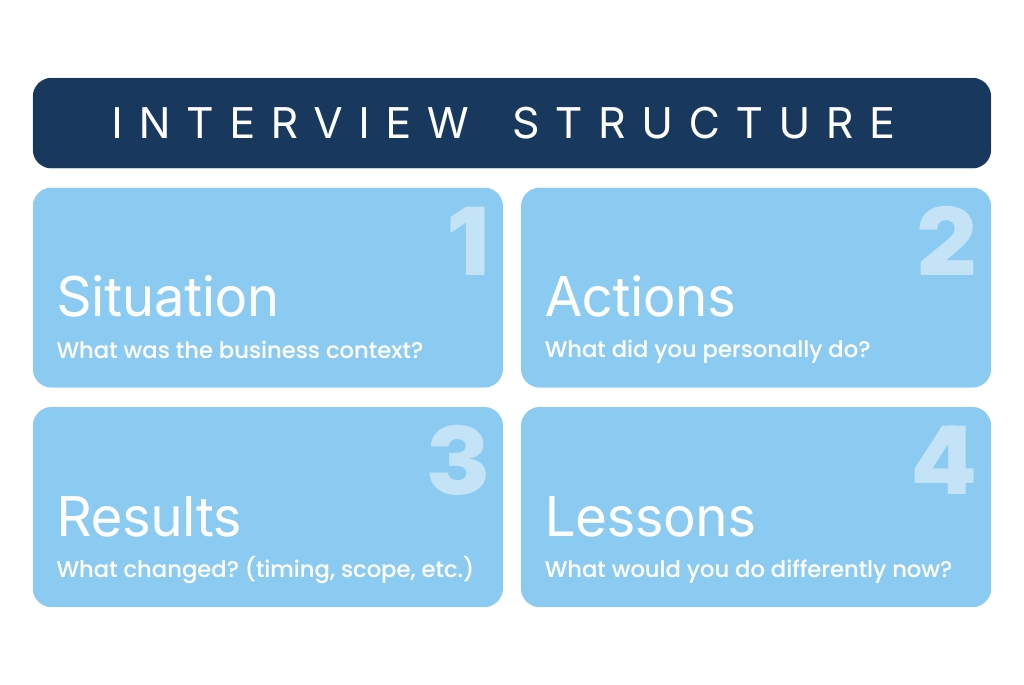
Here’s a great executive interview structure:
- Situation: What was the business context?
- Actions: What did you personally do?
- Results: What changed? (numbers, timing, scope)
- Lessons: What would you do differently now?
Then score each candidate against the “results sheet” from step 1.
If you want to add one extra layer:
- Ask for a short “first 90 days” plan
- Run one panel interview with key stakeholders
- Do references focused on outcomes (not personality)
This makes your executive recruiting strategies stronger without adding unnecessary steps.
Sell the Role Clearly (Because Top Executives Need a Reason to Move)
The best executives usually aren’t desperate. They’re cautious.
Your pitch needs to be clear and real. Be sure to answer these questions when selling your role to executives:
- Why this role?
- Why now?
- What’s the mission?
- What authority will they actually have?
- What support will they get?
Executives want to know that they’re joining something that is worth being a part of. WEF projects 170 million new jobs will be created by 2030 while 92 million are displaced (net +78 million).
With all of the changes going on in the current work environment, these executives want to be part of the right story. Companies need to be able to sell these candidates on the future of their company.
Move Fast Without Getting Sloppy
Slow hiring loses great people. But rushing can lead to bad hires.
Build speed into the process:
- Give feedback within 48 hours after interviews
- Have one clear decision-maker (avoid endless committees)
- Align on compensation early
- Make the offer message clear: outcomes + expectations + support
The biggest mistake here is waiting too long and letting a great candidate cool off.
Treat Onboarding as Part of the Hire (Because That’s Where Performance Starts)
If you want a leader to succeed, set them up for success.
Use a simple 30-60-90 day plan:
- First 30 days: listen, meet stakeholders, learn the business
- Next 30 days: identify priorities and quick wins
- Next 30 days: lock in a plan, metrics, and team alignment
When onboarding is messy, performance is messy. Ensure you have a plan in place to create a smooth and purposeful onboarding process for the executives joining your team.
A Simple 2026 Executive Recruiting Checklist
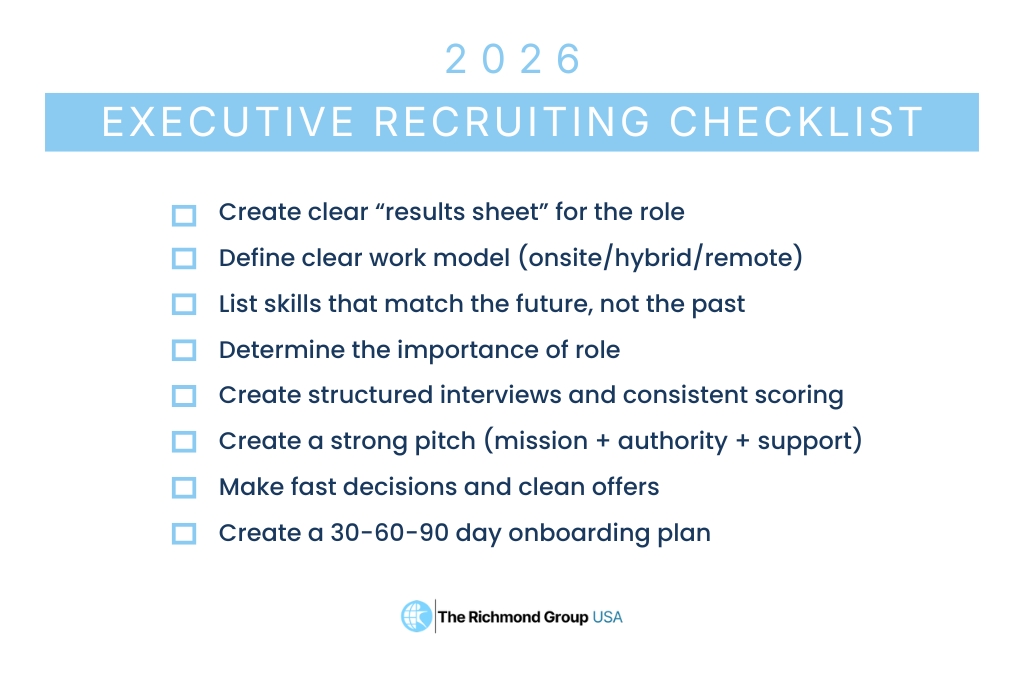
Here’s your quick checklist to follow when hiring a new executive in 2026:
- Create clear “results sheet” for the role
- Define clear work model (onsite/hybrid/remote)
- List skills that match the future, not the past
- Determine the importance of role
- Create structured interviews and consistent scoring
- Create a strong pitch (mission + authority + support)
- Make fast decisions and clean offers
- Create a 30-60-90 day onboarding plan
If you hit these, your hiring strategy plan will be stronger than most companies’ processes.
Where The Richmond Group USA Can Help
In 2026, companies often need extra help when:
- The role is confidential
- The role is specialized
- The timeline is tight
- You need passive candidates (not applicants)
The Richmond Group USA has been operating since 1967 and works as part of a larger family of talent solution companies.
If your team needs to move faster, reach harder-to-find candidates, or run a more structured search, that’s where a recruiting partner can make a real difference. The Richmond Group USA has access to a network of millions of potential active and passive candidates that can be used to help you find the executives you need.
To learn more about the executive search options from The Richmond Group USA, reach out to our team today. We’re here to help you improve your hiring strategies so your team can excel in 2026.
Phone: +1 (804) 285-2071
Email: info@richgroupusa.com