

A CEO Succession Plan Isn’t Enough. What the Board Really Needs…
Own capital decisions. Stand in front of investors. Manage a divided executive team. Manage the use of resources across the company. These are the real challenges a CEO faces in their daily life and they’re the skills that any potential successor should be able to prove they can handle.
Challenger, Gray & Christmas tracked 2,032 CEO exits in 2025, and public-company CEO exits reached 446, the highest annual total Challenger has recorded. Leadership change doesn’t always arrive on a clean retirement timeline. Sometimes it shows up after two bad quarters, an activist letter, a health event, a failed transformation, or a strategic reset that exposes the limits of the current leadership model. With these exits increasing, a strategic and carefully thought-out succession plan is becoming increasingly important.
The important question to ask your board now is: Could you defend your CEO succession decision with evidence tomorrow morning?
If the evidence isn’t there, then you don’t really have a succession plan; you have a risk.
TL; DR
A strong CEO succession process gives the board proof of ability.
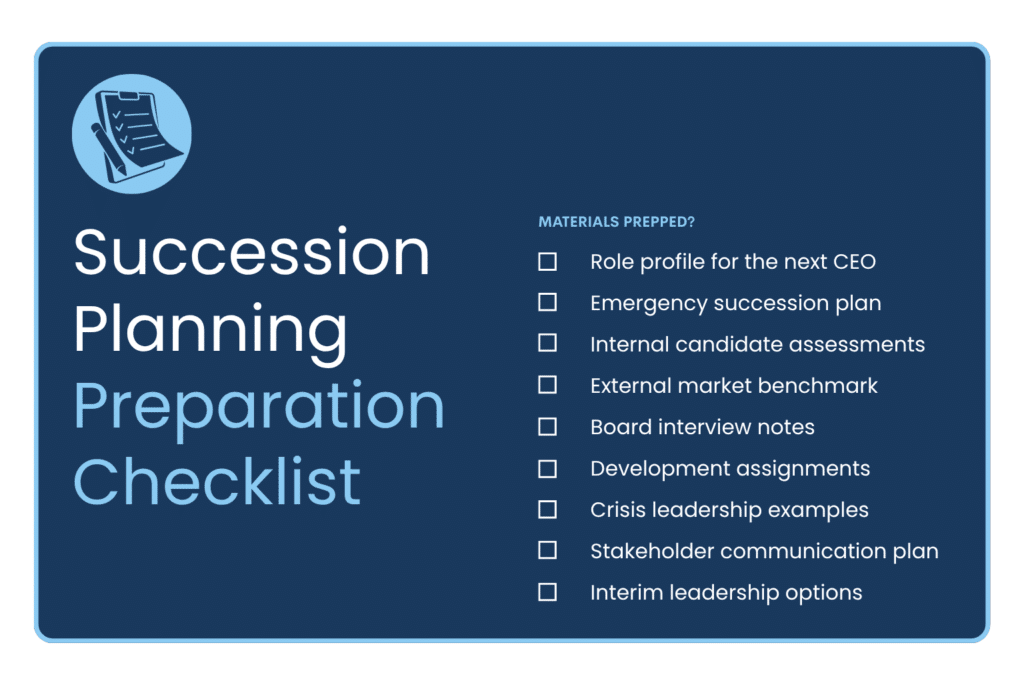
You need to know who can step in during an emergency, who could become CEO in the near term, and who needs more development before the company can trust them with the role. Internal candidates need evidence behind them. External benchmarking helps the board see whether the internal bench matches the market. Interim leadership can give the company stability when the board needs more time to make the permanent decision carefully.
Table of Contents
A Name on a Succession Plan Isn’t Proof
You can list three possible successors and still have no real succession readiness.
Maybe the COO knows the business well. Maybe the CFO has the board’s trust. Maybe a division president has delivered strong numbers for years. That’s good but now ask the harder questions.
Has that person handled a customer concentration problem when the largest account threatened to leave? Have they cut capital from a favored business unit and lived with the fallout? Have they led through a quality failure, lender pressure, an acquisition integration, or a major technology investment that didn’t go smoothly?
Boards get into trouble when they confuse familiarity with readiness.
A serious succession process builds a proof file. It shows how each candidate thinks, decides, communicates, and absorbs pressure. It identifies what the person has already proven at enterprise level and where the board would still carry risk.
Boards Need Three Succession Timelines
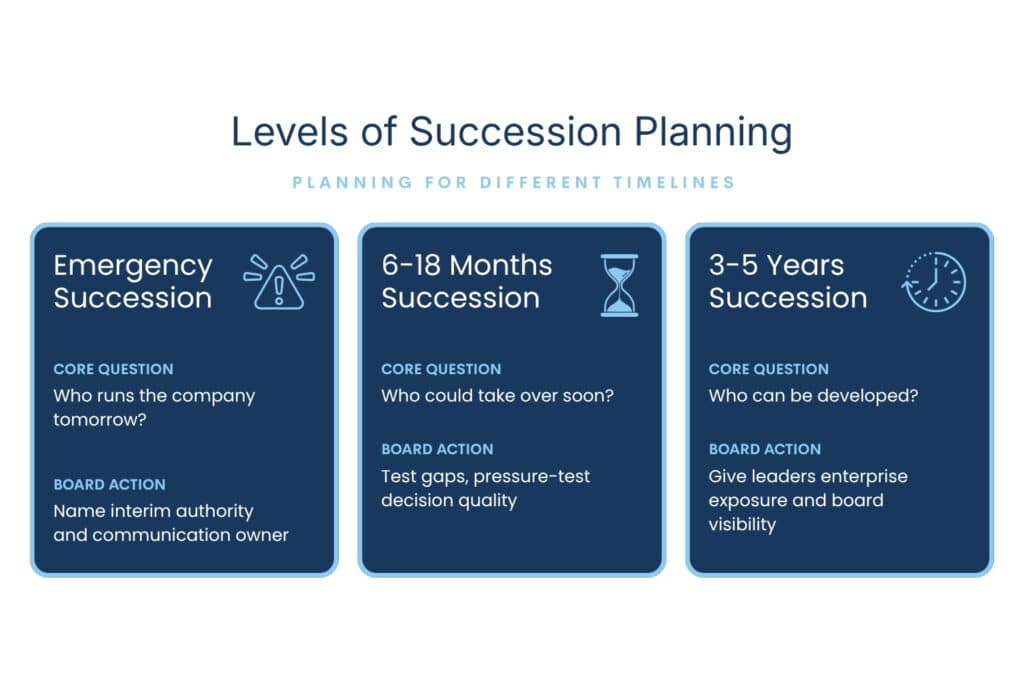
CEO succession readiness has three different timelines.
The first timeline asks: who runs the company tomorrow if the CEO leaves? That’s emergency readiness. If the CEO exits suddenly, who speaks to the leadership team? Who calls the bank? Who reassures the largest customer? Who has enough authority to stop the rumor mill before it starts making decisions for you?
PwC advises boards to identify interim candidates who can step in quickly, often a CFO, COO, another senior executive, a former CEO, or even a director if no clear operating candidate exists.
The second succession timeline asks: who could take over the role in the next 6 to 18 months? This person may already sit inside the company, but the board still needs to test the skill gaps. Can they lead former peers? Can they move from functional advocacy to enterprise judgment? Can they handle board pressure without being performative?
The third timeline asks: who could become CEO in three to five years if you start building them now? That timeline gives the board more control. You can put promising leaders in front of the board, give them cross-functional ownership, and watch them lead through a plant launch, pricing reset, acquisition integration, or turnaround.
Potential becomes useful only after pressure tests it.
Start With the Future CEO Profile
Your next CEO shouldn’t function as a tribute to the current one.
The current CEO may have built the company through sales grit, plant discipline, founder authority, or deep product knowledge. That history deserves respect, but it shouldn’t dictate the company’s future.
Before you evaluate successors, ask one question: What problems will the next CEO actually have to solve?
Maybe the next leader needs to professionalize a founder-led company. Maybe they need to integrate acquisitions. Maybe they need to automate production without losing trust on the floor. Maybe they need to manage tariffs, restructure debt, prepare the company for sale, or rebuild the commercial engine.
Each of those scenarios requires a different skillset from CEOs.
Internal Candidates Need Evidence
Internal succession often gives the board the cleanest transition. The candidate knows the business, people, customers, politics, and operating constraints.
The Conference Board reported that in 2024, 59% of new Russell 3000 CEOs and 77% of new S&P 500 CEOs came from internal promotions. Internal succession clearly works when the company has built the bench deliberately.
But internal knowledge doesn’t prove CEO readiness.
A strong COO may run operations beautifully and still lack investor credibility. A strong CFO may understand the business model and still lack commercial range. A division president may deliver results and still struggle when peers start judging them as the final decision-maker.
Boards should look for evidence of competence in specific areas:
- Enterprise P&L judgment
- Capital allocation decisions
- Cross-functional authority
- Crisis response
- Board-level communication
- Strategic decision-making with incomplete information
- Credibility with customers, lenders, investors, and senior leaders
Internal promotion works best when the candidate has proven scope, credibility, and decision quality beyond a narrow function.
The risk comes when the board promotes the most familiar person instead of the strongest CEO.
External Benchmarking Gives the Board a Market Test
A board can believe in an internal successor and still ask: “How does this person compare to CEOs and CEO-ready executives in the market?”
Asking that question protects the board from familiarity bias. It can also protect the internal candidate. If they’re strong, outside calibration confirms it. If they’re not ready, the board can name and address the gap before it causes public facing issues.
The Conference Board found that companies with declining performance more often look outside for CEO talent. In 2023, companies that hired external CEOs had a previous-year median one-year total shareholder revenue (TSR) of negative 8%, while companies that promoted internal CEOs had median TSR of positive 2%.
That doesn’t prove outside hiring fixes performance. It shows that boards often look externally when the company needs a different capability, credibility reset, or strategic break from the past.
The Richmond Group USA can help boards and ownership teams compare internal candidates against the external executive market, map confidential CEO talent, and evaluate whether the internal bench matches the company’s next chapter.
Emergency Succession Needs Its Own Plan
An interim CEO solves a different problem than a permanent CEO.
The interim leader’s job is to stabilize the business, hold the executive team together, keep lenders calm, give customers confidence and prevent one leadership gap from turning into five operating problems.
The Conference Board’s 2024 succession review found that interim CEO roles often last between two and 10 months, and only 9% of interim CEOs at Russell 3000 companies secured the permanent CEO role in 2024.
An interim CEO doesn’t have to audition for permanence. Sometimes the right interim leader just gives the board enough room to avoid a rushed permanent decision.
The Richmond Group USA’s sister company, PeopleSolutions, supports urgent interim executive needs when companies need experienced leadership during sudden departures, permanent-search coverage, turnarounds, integrations, plant launches, systems transitions, and finance cleanups.
Straightforward interim leadership assignments may move from kickoff to shortlist in 1 to 3 weeks, with placement sometimes happening in 2 to 5 weeks, depending on role and market conditions.
With interim leaders, you can solve the immediate leadership problem without pretending you already know the permanent answer.
The Board Has to Prove Its Own Readiness
A strong candidate can still fail inside a weak succession process.
Does the board agree on what the next CEO needs to do? Does the current CEO influence the process without controlling it? Can directors challenge a favored internal candidate without turning the conversation personal? Will the board act if the evidence points away from the comfortable choice?
PwC’s 2025 board priorities work found that 55% of directors think at least one fellow board member should be replaced. PwC also reported that only 32% of executives say their boards have the right mix of skills and expertise.
CEO succession readiness includes board readiness. If directors can’t align on strategy, role profile, decision rights, candidate evidence, and communication, succession planning can turn into a personality contest.
Proof Beats Comfort
A CEO succession plan should work like a stress test.
Who can step in tomorrow? Who can lead the next chapter? Who only looks ready because everyone knows them? Who does the external market prove you’re missing?
A plan gives you a list of names. Proof gives you confidence in the successors you choose.
To discuss the ways that The Richmond Group USA can assist with your business succession planning, reach out to our team for an initial conversation! If you’re in need of immediate assistance, reach out to our partners at PeopleSolutions to find an interim leader that can confidently run the business while you work on a permanent succession plan.
